


Why Is Bitcoin Falling Today? Reasons and Scenarios for BTC

Home > Blog > Cryptocurrency Knowledge and Market > Article: “Why Is Bitcoin Falling Today?...”
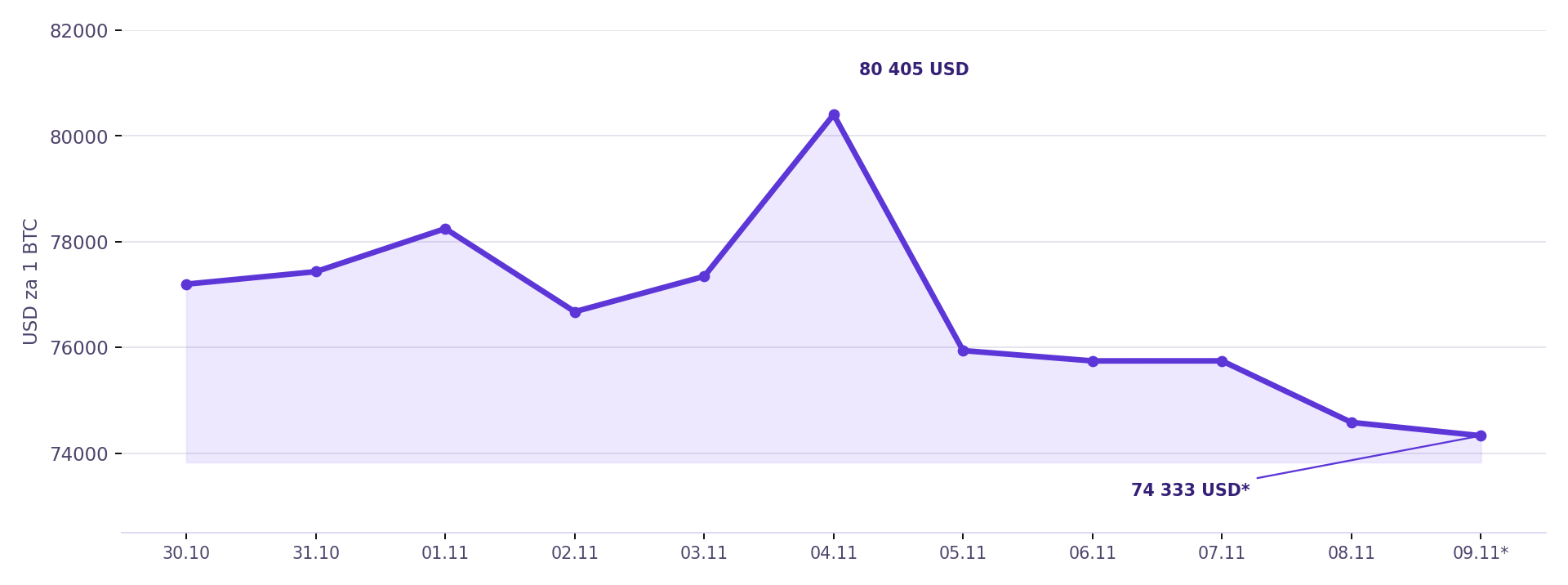
On November 9, 2026, Bitcoin once again came under selling pressure. In morning trading, the price fell to around $73,708, its lowest level in over two months. The market was weighed down by concerns over tighter cryptocurrency regulations in the U.S., reports of a major security incident in the industry, and capital outflows from spot Bitcoin ETF funds. These are specific events, but that doesn’t mean a precise percentage of today’s decline can be attributed to each one.
For those tracking the exchange rate in Switzerland, it’s not just the BTC/USD fluctuation that matters, but also the price in CHF and the difference between the market rate and the rate at the point of purchase. Below, we separate facts from hypotheses, present three scenarios, and explain what you really need to check before deciding to buy.
“Bitcoin fell 2%” doesn’t mean much without a point of reference. What matters is whether we’re comparing the change over the past 24 hours, from the market open, or from a previous local high. On November 9, Reuters reported that Bitcoin had fallen by more than 2% to around $73,708, a level not seen since August. Additionally, Ether weakened, indicating that this movement was not limited to a single asset.
Why might the BTC/CHF exchange rate behave differently than the BTC/USD rate? Because the price in Swiss francs also depends on the USD/CHF exchange rate. Similarly, the exchange rate in euros is relevant to readers in Germany and Austria. Therefore, in the DACH market, it’s worth quoting all three currencies, but you shouldn’t treat the percentage differences between them as an error.
1. Regulatory Concerns Following the U.S. Election
The most immediate context for today’s news is political and regulatory in nature. According to Reuters, investors were concerned that, following the U.S. congressional elections, the new balance of power might lead to a stricter approach toward the cryptocurrency market. This is not about a single bill that has already been passed, but rather about market participants’ expectations. When future regulations become less predictable, some investors reduce their risk in advance, before any concrete decisions are made.
This is a good example of the difference between fact and interpretation: the fact is the price decline and the publicly reported uncertainty; the exact portion of the price drop caused by the policy itself remains a hypothesis. At the same time, the market reacts to a variety of news.
2. A security incident in the cryptocurrency industry
In recent days, investors have also been digesting news of a massive security incident involving Binance. In an explanatory article, Reuters described the theft of digital assets worth approximately $6.3 billion. Such events can undermine confidence in the market’s infrastructure and prompt some participants to temporarily reduce their exposure. However, the risks associated with a specific platform should not be conflated with the technical security of the Bitcoin network itself.
3. Outflows from spot Bitcoin ETF funds
At the same time, institutional flows were declining. Data analyzed by The Block shows that during the week of November 2–6, U.S. spot Bitcoin ETFs recorded a total of approximately $1.28 billion in net outflows. On Friday, November 6, alone, outflows totaled approximately $411.9 million. This is a clear sign of weaker demand for this form of exposure, but ETFs do not represent the entire market: trading also takes place on spot exchanges, the futures market, and over-the-counter.
4. Position Liquidations and Overall Investor Sentiment
The decline may accelerate when leveraged positions are closed out in the derivatives market. If the price falls below the required margin level, the exchange may liquidate the position, and subsequent selling exacerbates the decline. This is a well-known mechanism, but without separate, verified data, it cannot be claimed that it was responsible for a specific amount of the November sell-off.
The macroeconomic environment is also significant: bond yields, interest rate expectations, the dollar exchange rate, and the performance of tech stocks. Bitcoin often reacts to changes in risk appetite, though it does not always move in exactly the same way as stock market indices. Before identifying a specific macroeconomic driver, it is necessary to verify temporal consistency and the data.
The word “crash” is sometimes used even to describe a one-day sell-off, but there is no single universal threshold that automatically determines the name of the market movement. A correction is usually defined as a pullback in price following prior gains. A crash implies an exceptionally rapid and steep decline, often accompanied by panic, a deterioration in liquidity, and a strong reaction across many segments of the market.
In the case of Bitcoin, the pace and starting point are particularly important. A drop of a few percent in a single day can be painful for leveraged positions, but it doesn’t necessarily mean a bear market lasting several months. On the other hand, the mere fact that BTC has historically rebounded after declines does not guarantee a similar rebound in the next cycle.
There is no reliable way to determine BTC’s future low based on a single trading session. Instead of relying on a single forecast, it’s better to monitor three possible scenarios and the signals that might support them. None of the scenarios below guarantees a specific price level or a date when the sell-off will end.
It’s worth tracking not just a single alarming headline, but a set of data points: inflows into ETFs, volatility, market behavior following regulatory announcements, trading volume, and the reaction to successive local lows. A brief period of stabilization can precede either a rebound or another wave of declines.
A lower BTC price isn’t automatically a “sale.” Anyone considering a purchase should first and foremost know how much they could lose, how long they intend to hold the investment, and whether they’ll need that money in the coming months. A highly volatile asset can be bought for less than it cost a week earlier, only to see its price drop even further.
Some market participants use DCA, which involves making regular purchases for a predetermined amount, such as once a month. This method reduces the importance of choosing a single entry date, but it does not protect against market declines and does not guarantee a profit. Others prefer to wait for a calmer period. Each approach has its own opportunity cost and risk.
Before making a purchase, it’s important to distinguish between actually owning BTC and investing in a product that tracks its price, as well as to determine how you will store your funds. You should not make a decision under pressure from an online message about a “last chance.” More basics are described in the guide “How to Invest in Bitcoin?”
A Bitcoin ATM is one way to exchange cash for cryptocurrencies. It is not, in itself, an investment strategy or a guarantee of a better exchange rate. In Switzerland, users can find physical locations on the Rothbard.eu map and, before visiting, check the BTC purchase function, the device’s status, access hours, and the operator’s verification requirements.
When buying BTC with CHF, it’s important to distinguish between the BTC/CHF market quote and the final exchange rate applied by the device. The final amount can be affected by the spread, the operator’s commission, any flat fee, and network fees. The most practical question is: exactly how much BTC will I receive for the amount I deposit? Two offers with similar percentage commissions may result in different amounts if they set the exchange rate differently.
Before confirming, open the “Receive” option in your wallet, make sure you select Bitcoin on the correct network, and then compare the address shown in your wallet with the address read by the device. Do not use a QR code received from a stranger, and do not share your recovery phrase with anyone. Keep the confirmation and check your BTC balance after the transaction is processed.
Related guides and a map on Rothbard.eu
• Map of Bitcoin ATM locations in Switzerland
• What are the fees at an ATM Bitcoin?
• Wallet for a Bitcoin ATM – Guide
• Buying BTC with cash in Switzerland
Why is Bitcoin falling today?
On November 9, 2026, confirmed factors included regulatory concerns in the U.S., a security incident in the industry, and significant outflows from spot Bitcoin ETF funds. It is not possible to attribute a precise portion of the decline to any single factor.
Could Bitcoin fall even further?
Yes. Further declines, stabilisation, and a rebound are all possible. The cryptocurrency market is volatile, and a local bottom cannot be predicted with certainty.
When will Bitcoin go up again?
There is no reliable date. A rebound may depend on demand, liquidity, new regulatory developments, and broader financial sentiment.
Does the current decline constitute a crash?
You can't determine this based on the headline alone. You have to take into account the depth and pace of the sell-off, market liquidity, the previous trend, and the reaction of the market as a whole.
Does a lower BTC price mean it's a good buying opportunity?
Not always. A lower price may be attractive, but it may also precede a further decline. Your budget, risk tolerance, investment horizon, and transaction costs all matter.
Why does the BTC price at a Bitcoin ATM differ from the market price?
The operator may apply its own exchange rate, spread, commission, and other fees. Therefore, be sure to check the final amount of BTC you will receive in exchange for cash before confirming the transaction.
Bitcoin’s November decline cannot be attributed to a single headline. The market reacted to regulatory concerns following the U.S. election, a security incident, and a slowdown in inflows to ETFs. The direction of future price movements remains uncertain. For readers in Switzerland, the price in CHF and the total cost of the chosen purchase method are just as important as the BTC/USD exchange rate. Before taking any action, it’s worth comparing the data, understanding the risks, and reviewing the terms of the specific transaction.
Rothbard.eu is developing the Bitcoin ATM aggregation platform in Switzerland, allowing users to find locations where they can buy and sell BTC and other cryptocurrencies for cash. The kiosks are available in Zurich, Geneva, Basel, Lausanne, Lucerne, Lugano, and Mendrisio, among other locations, and their current status and availability of funds can be checked online on the website’s map.
This material is for informational purposes only. It does not constitute investment, tax, or legal advice.