
Help


Home > Blog> Article: “How much are the fees...”
Updated: June 30, 2026
The figures below are simplified estimates based on the typical range of Bitcoin ATM fees. They do not show the price of any specific machine. They assume that the total cost includes the commission, the spread, and any flat fee.
Example for $100: with a 15% commission, a $3 flat fee, and an additional spread, the user may receive BTC worth clearly less than $82.
With a $20 purchase, the flat fee takes a large part of the deposit even before the commission and spread are included.
A Bitcoin ATM makes it possible to buy BTC quickly with cash, but operating it is more expensive than running an online exchange. The operator pays for physical infrastructure: cash handling, transport, security, machine servicing, location, internet, anti-money-laundering procedures, transaction monitoring, documentation, user support, and exchange-rate risk.
That is why Bitcoin ATM fees do not come only from the transaction itself. As the Federal Reserve Bank of Kansas City notes in its 2023 analysis of the cash-to-crypto Bitcoin ATM market, the operator handles cash, the machine, the location, regulatory compliance, and operational risk. This is different from an online exchange, where most of the process is digital.
In addition, operators set their own commissions and rates, and less competition in a given location can mean a higher total purchase cost.
These are only examples of the percentage commission itself. The real cost may be higher if the machine adds a flat fee, a network fee, or uses a less favorable BTC rate.
A cryptocurrency exchange is an online platform for buying and selling digital assets. It usually offers lower costs than a Bitcoin ATM, but it requires an account, verification, and an electronic payment method. A Bitcoin ATM may be simpler for someone who wants to use cash.
You should compare the full cost, not just the name of the purchase method. An exchange may also apply a spread and fees for deposits, withdrawals, or network transfers, but a Bitcoin ATM may be more expensive because it involves cash handling and physical infrastructure.
A Bitcoin ATM can make sense when the user wants to buy BTC with cash, does not want to start with an exchange, needs a simple process, or prefers a physical access point. The higher cost is then the price of convenience, cash, and local availability.
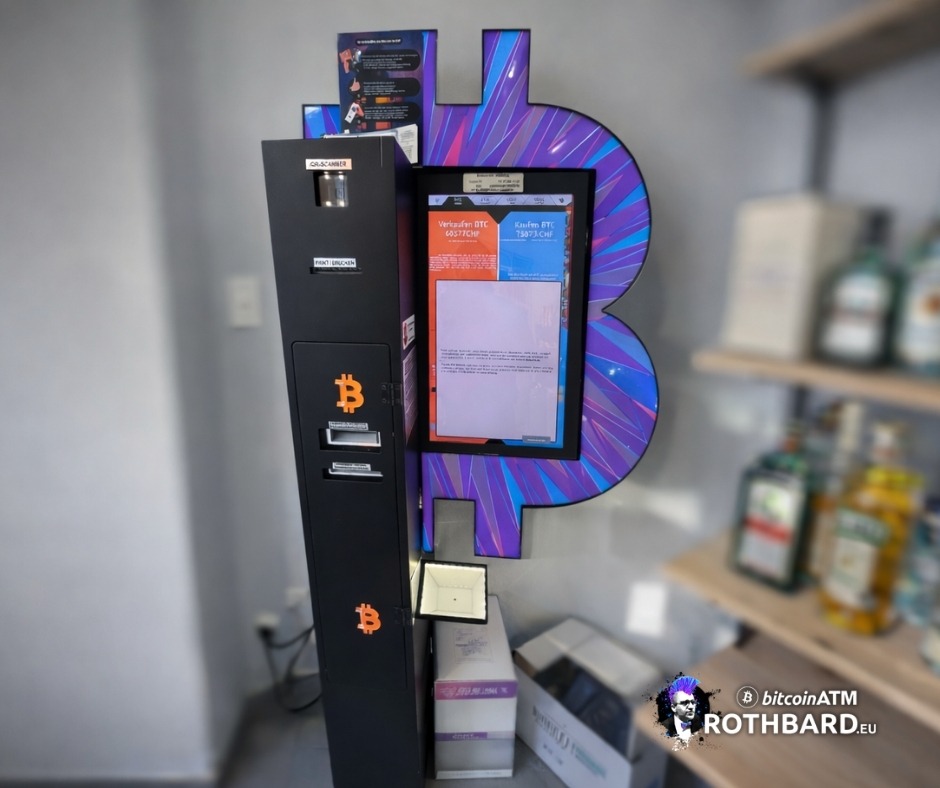
In Switzerland, this choice often comes down to practical needs as well: whether the user wants to pay cash in CHF or prefers a bank transfer, card, or exchange account. With a Bitcoin ATM, it is worth comparing the fee percentage, BTC rate, machine availability, opening hours, and final amount of BTC shown before you confirm the transaction.
Do not insert cash until you understand the purchase terms. Cryptocurrency transactions are irreversible.
Before confirming the transaction:
No. High fees at a Bitcoin ATM do not automatically mean a scam. A legally operating machine may charge a high fee because of the operator’s costs and pricing policy.
However, Bitcoin ATMs are sometimes used by scammers as a way to take money from victims. The Federal Trade Commission warned in 2024 that the pattern is often similar: a scammer contacts the victim, persuades them to deposit cash at a Bitcoin ATM, and sends their own QR code to scan.
Stop the transaction if someone:
Real companies and government offices do not tell people to deposit cash into a Bitcoin ATM to “secure” their funds. FinCEN also noted in its August 4, 2025 notice that cryptocurrency kiosks can be used in fraud, cybercrime, and illegal activity.
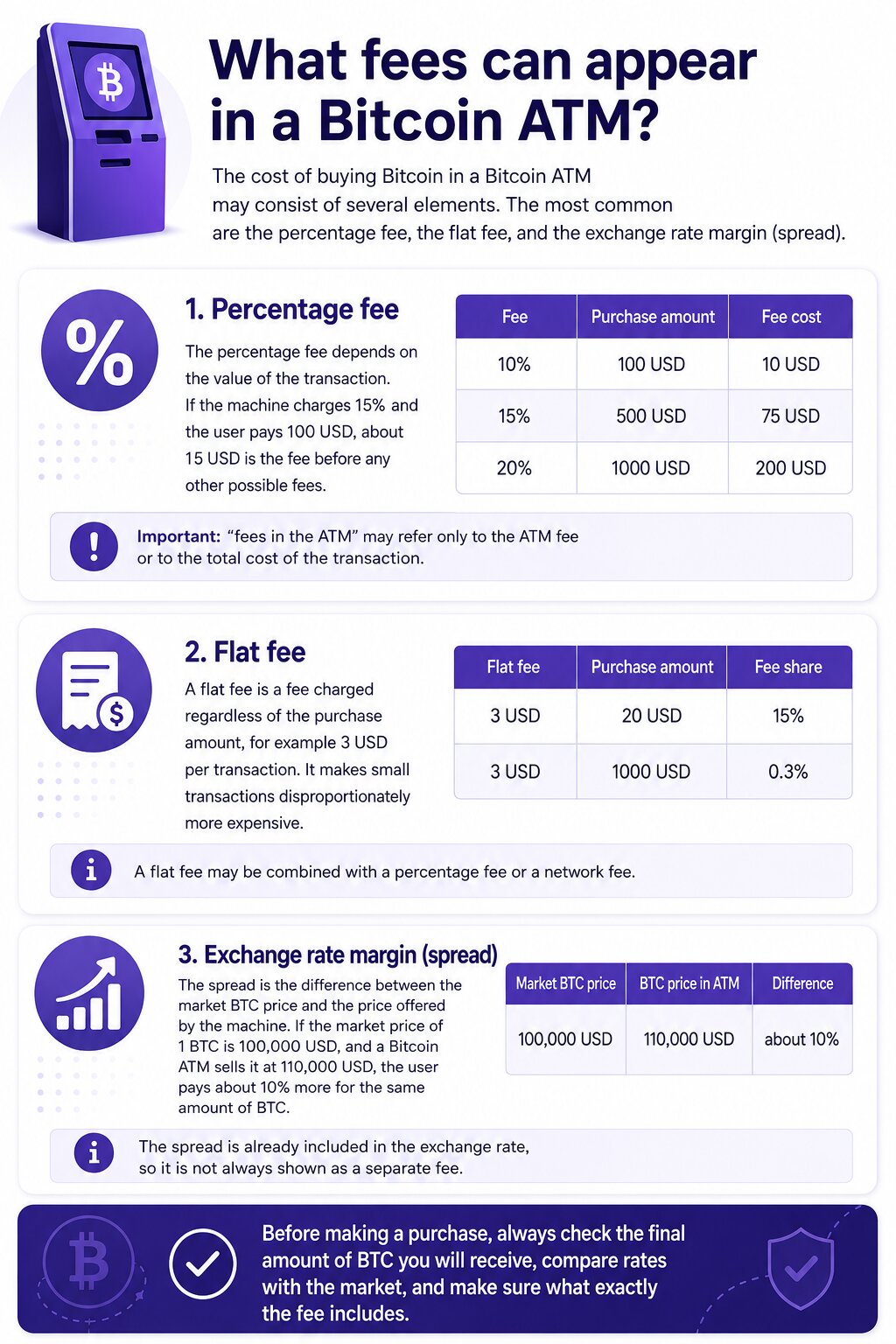
The most effective way to reduce costs is to compare the whole transaction before depositing cash. The visible percentage is not enough if the rate includes an additional spread.
To reduce Bitcoin ATM fees, it is worth avoiding very small transactions burdened by a high flat fee, comparing machines and their rates without choosing an operator only because of advertising, and checking the current BTC price right before buying. Before confirming the transaction, it is also useful to calculate the value of BTC you will actually receive, consider a cryptocurrency exchange if you can pay by bank transfer or another electronic method, and approve the purchase only when the final cost is clear and acceptable.
It is not possible to avoid all fees completely, because the operator provides a paid service and sending BTC may involve a network cost. However, you can avoid an unnecessarily high fee by comparing offers and walking away from an unfavorable transaction before confirming it.
In this article, “fee at a Bitcoin ATM” means the user’s total cost, not only the commission shown as a separate line item. The cost includes the percentage commission, flat fee, exchange-rate spread, and any network fee.
This article deliberately separates the commission shown on the screen from the total transaction cost. That helps the user judge the real purchase price, not the name of one fee.
If you use a Bitcoin ATM in Switzerland, treat checking the machine online as part of cost control. Location, status, opening hours, and cash availability can be just as practical as the commission itself. You can check current points in Switzerland on the Rothbard Bitcoin ATM map in Switzerland before starting the transaction.
With a typical cost of 10–25%, a user may receive BTC worth about $75–$90. The result depends on the commission, flat fee, and spread. Therefore, before buying, you should check the specific rate and transaction summary.
This means an effective cost of about 35%. With such a small amount, even a fixed fee of a few dollars has a large impact, and after adding the commission and spread, total BTC ATM fees can exceed 30%.
Usually, yes. These machines handle cash and physical infrastructure, which is why they charge higher fees. An online exchange is generally cheaper, but it requires an account, verification, and an electronic payment method.
Some costs may not be shown as a separate line item. The most common example is the spread, meaning the margin included in the BTC rate. That is why it is worth comparing the machine’s rate with the market rate and checking the final value of the Bitcoin you receive.
Usually, you cannot avoid them completely. However, you can reduce fees by avoiding small deposits, comparing rates, and choosing another purchase method when the machine shows a cost that is too high.
It can be safe if the user uses their own wallet, starts the purchase themselves, and understands the costs. You should not make a transaction because an unknown person told you to do so, and you should not scan a QR code they sent. In that situation, the risk of fraud is very high.
Not always. The operator may show it as a separate line item or include it in the total transaction cost. That is why you need to look at the final amount of BTC that will reach the wallet.
How much are the fees at a Bitcoin ATM? Usually 10% to 25%, but with small transactions the total cost can exceed 30%. The final price is affected by the percentage commission, flat fee, spread, and sometimes a network fee.
A Bitcoin ATM can be a convenient way to buy BTC with cash, but it usually costs more than a cryptocurrency exchange. Before confirming, always check the BTC rate, the transaction summary, and the value of Bitcoin that will reach your wallet. High fees at a Bitcoin ATM are not proof of a scam by themselves, but never use an ATM because someone contacted you unexpectedly and told you to do so.
NEW!
Rothbard.eu is developing a platform that aggregates Bitcoin ATMs in Switzerland, allowing users to find locations where they can buy and sell BTC and other cryptocurrencies for cash. The machines are available in cities such as Zürich, Genève, Basel, Lausanne and Luzern, and their current status and cash availability can be checked online on the service’s map.
This material is for informational purposes only. It does not constitute investment, tax, or legal advice.
%20(1).jpg)


