


Home > Blog > Article: “What is Bitcoin SV (BSV)?…”
A comprehensive, neutral guide to BSV’s origins, how its network works, how it differs from BTC and BCH, its tokenomics and the key controversies surrounding it.
.jpg)
------------------------------------------------------------------------------
Bitcoin SV (BSV) is a cryptocurrency and public blockchain that emerged on 15 November 2018 following a split in Bitcoin Cash. Put simply, BSV inherits part of Bitcoin’s history, but now operates as a separate chain with its own rules, asset and ecosystem.
Bitcoin SV is a layer-one blockchain and the name of its native coin. The project was launched as a Bitcoin Cash hard fork in November 2018, approximately sixteen months after BCH split from Bitcoin. Supporters of the network favour scaling directly on the main chain, very large blocks, low per-transaction fees and extensive use of Bitcoin Script.
BSV is not the same asset as BTC or BCH. Following the forks, each branch has its own nodes, consensus rules, markets, and wallets.
The dispute originated in the debate over Bitcoin’s scalability: whether more payments should be processed primarily on the main chain or also off-chain, for example through layer 2 solutions. In 2017, part of the community and some miners opted for larger blocks, creating Bitcoin Cash
A year later, BCH split again. The Bitcoin SV camp opposed some of the changes planned by Bitcoin ABC and wanted to increase on-chain throughput more quickly. The dispute involved technical parameters and protocol governance.
The Bitcoin Cash fork — how the split unfolded
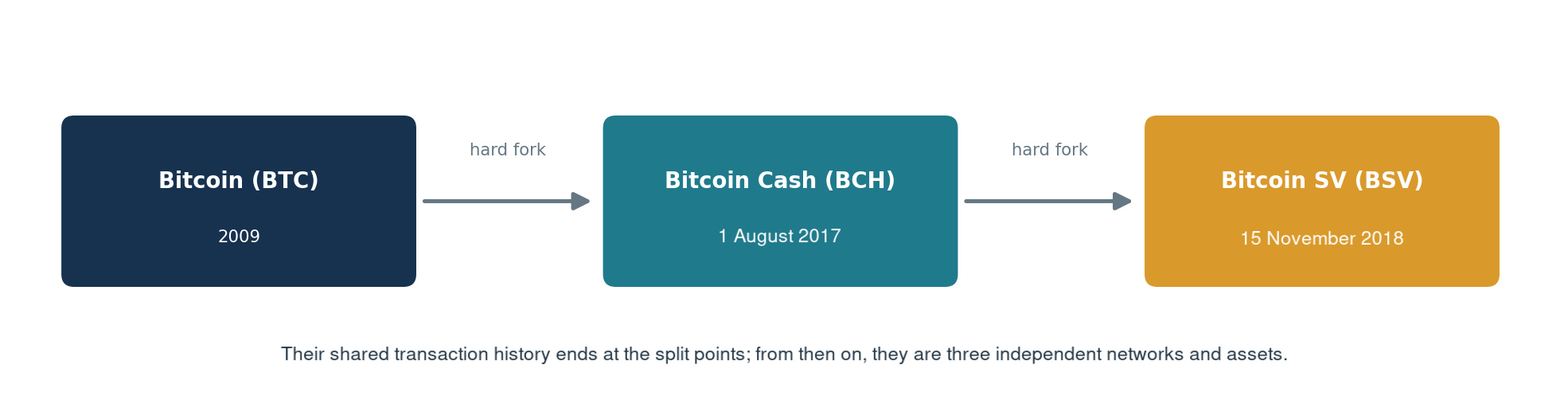
The relationship between these projects is best viewed as a family tree: BTC → BCH → BSV. Bitcoin Cash split from the BTC network on 1 August 2017, and BSV split from BCH on 15 November 2018. After each split, the shared history ends at a specific block, and subsequent transactions are recorded on independent chains.
A newer branch does not replace an older one. A wallet must support the correct network, and exchanges make separate decisions about listings, deposits and withdrawals.
What does “Satoshi Vision” mean?
The name Bitcoin Satoshi Vision refers to the project’s stated aim of restoring the model described as peer-to-peer electronic cash. BSV supporters argue that a stable original Bitcoin protocol, on-chain payments and scaling through large blocks best implement the principles set out in Satoshi Nakamoto’s white paper.
This is the project’s positioning, not an undisputed historical verdict. The BTC and BCH communities interpret Bitcoin’s priorities differently, so the term “Satoshi’s vision” should not be treated as proof that one branch is the sole legitimate Bitcoin.

The basic operating model is similar to that of other networks derived from Bitcoin. Transactions are broadcast to nodes, miners assemble them into blocks, and the remaining nodes verify the signatures, the rules governing the spending of coins and the new block’s compliance with the protocol.
Proof of work
The network uses proof of work and the SHA-256 hash function. Miners compete to find a hash that satisfies the difficulty target; the winning block provides proof of the work performed, and the valid chain is assessed according to its cumulative work.
Rewriting transaction history would require redoing the work of successive blocks faster than the honest network. Security also depends on the distribution of hash rate, economic incentives and how operators respond to reorganisations.
Block size and scalability
The most distinctive feature of BSV is its approach to block size. Following the 2020 Genesis update, the fixed default limit was removed from the protocol rules, and node operators now configure limits for accepting and mining blocks. The project refers to this model as “unbounded”, although in practice the limits are determined by hardware, network bandwidth, propagation time and miner economics.
Large blocks are intended to increase scalability and reduce the cost of individual transactions. However, they require more memory, bandwidth and computing power, making it more difficult to run a full node and potentially contributing to centralisation.
UTXO model and Bitcoin Script
BSV uses the UTXO model, which stands for unspent transaction outputs. A wallet’s “balance” is the sum of UTXOs that can be unlocked with the appropriate signature; spending a coin consumes the previous output and creates a new one, including any change.
Bitcoin Script defines the conditions for unlocking funds and can support multisig, timelocks, tokens, data and smart contracts. Unlike Ethereum, the logic remains tied to specific UTXOs and transactions.
Bitcoin SV vs Bitcoin vs Bitcoin Cash
All three networks use SHA-256 proof of work and aim for a block time of approximately ten minutes, but they differ in their approaches to development, capacity and primary use cases. The table shows each project’s design direction, not an investment assessment.
BSV tokenomics: supply, mining and fees
The ticker symbol for the native coin is BSV, and the maximum supply is 21 million units. New coins are not issued by a foundation or through staking; they are created as part of the block reward through mining. The supply actually available may be lower because lost private keys cannot be recovered.
A miner’s reward consists of the block subsidy and transaction fees. Following the 2024 halving, the subsidy is 3.125 BSV per block and halves every 210,000 blocks, or roughly every four years. Over the long term, fees from a large volume of transactions are expected to account for a growing share of revenue.
The fee is usually the difference between the sum of a transaction’s inputs and outputs, and its minimum level depends on the transaction data size, the chosen miner’s rules and network conditions. A low per-transaction fee does not guarantee a fixed price: operator policies and demand can change.

The BSV Association is a Swiss non-profit organisation that promotes adoption, provides education and developer support, and coordinates some work on standards and infrastructure. However, it is not the network’s only participant: independent operators and companies also develop software and services and set mining policies.
nChain historically played an important role in research and development and patenting. Craig Wright was a prominent ideological advocate, while Calvin Ayre, associated with Ayre Group and CoinGeek, was a sponsor and promoter. Neither Wright nor Ayre has exclusive control over proof-of-work consensus.
The project entails technical, reputational and market risks. BSV has less liquidity, availability on exchanges and hashing power than BTC, and its history includes personal disputes, delistings and attacks.
Craig Wright and the claim that he is Satoshi
For years, Craig Wright claimed to be Satoshi Nakamoto. In May 2024, the High Court of Justice held in COPA v Wright that he was not the author of the white paper, the creator of Bitcoin or the person behind the pseudonym Satoshi. The written judgment also described extensive use of forged documents.
The ruling weakened a key promotional narrative surrounding Wright. It does not technically disable the network or automatically determine the usefulness of the software, but it remains a significant reputational and legal factor.
Exchange delistings and attacks on the network
In April 2019, Binance announced that it would delist BSV following a periodic review and cited criteria including team activity, network stability, communication, ethical standards and contribution to the ecosystem. The decision limited availability on one of the largest platforms; in subsequent years, BSV remained available on fewer exchanges than BTC.
In 2021, the network experienced several deep chain reorganisations. Analysts and the media described them as 51% attacks, while the organisation associated with the project described them as malicious reorganisation attacks involving attempted double-spends. These events highlighted the risks faced by a blockchain that shares the SHA-256 algorithm with a much stronger network but has a lower hash rate of its own.
Other risks include price volatility, limited liquidity, high infrastructure requirements, uneven wallet support and regulatory changes. These factors should be assessed independently; they are not an argument for buying or selling.
As at 10 July 2026, examples of spot markets included the BSV/EUR pair on LCX and BSV/USDT on Gate and MEXC, while Ramp Network offered purchases through an on-ramp service. Availability depends on the country, the user’s status, KYC procedures and current support for deposits and withdrawals.
Before a transaction, check that your wallet supports the network, and verify the minimum withdrawal amount, fees, address compatibility and regional restrictions. Make sure that you are buying native BSV, not a derivative. This is educational information, not investment advice.
BSV remains an active but smaller and controversial branch of the Bitcoin blockchain family. Its distinctive features are aggressive on-chain scaling and the assumption that professional infrastructure will handle increasingly large blocks.
The key issues are the trade-offs: greater capacity and potentially lower fees in exchange for higher hardware requirements, a smaller ecosystem, lower liquidity and reputational risks. An assessment should be based on technical data, actual use and current market conditions, not slogans.
1. What is Bitcoin SV in simple terms?
It is a separate blockchain and cryptocurrency that branched off from Bitcoin Cash in 2018. The network focuses on large blocks, on-chain payments, and data processing on the main chain.
2. What does BSV stand for?
BSV stands for Bitcoin Satoshi Vision. The name describes its supporters’ stated attempt to realise the vision of peer-to-peer electronic cash.
3. Is Bitcoin SV the same as Bitcoin?
No. Both networks share a common early history, but since the forks, they have operated independently and have different rules, software, assets, and markets.
4. Why did Bitcoin SV split from Bitcoin Cash?
The split resulted from a dispute over scaling parameters, the scope of protocol changes and how BCH development should be governed. In November 2018, the conflict led to the creation of two chains.
5. How is the Bitcoin SV network secured?
The network is secured by SHA-256 proof of work. Miners create blocks, while nodes verify transactions and select the chain with the greatest cumulative work.
6. How many BSV coins can there be?
The maximum supply is 21 million coins. Issuance falls with each halving, and the actual number of available coins may be lower due to lost keys.
7. Is Bitcoin SV controversial?
Yes. The controversies include Craig Wright’s claims to be Satoshi, exchange delistings, governance disputes and the 2021 network reorganisations.
8. Where can you buy BSV?
Availability changes over time and depends on the jurisdiction. Check current spot markets, whether deposits and withdrawals are operational, and wallet compatibility before using any platform.
Rothbard.eu is developing a platform that aggregates Bitcoin ATM locations in Switzerland, enabling users to find locations where they can buy and sell BTC and other cryptocurrencies for cash. Bitcoin ATMs are available in cities including Zurich, Geneva, Basel, Lausanne and Lucerne; their current status and cash availability can be checked online on the website’s map.
This material is for informational purposes only. It does not constitute investment, tax or legal advice.