
Help



Home > Blog > Article: “The U.S. Lost Thousands of Bitcoin ATM Machines…”
Data as of August 18, 2026.
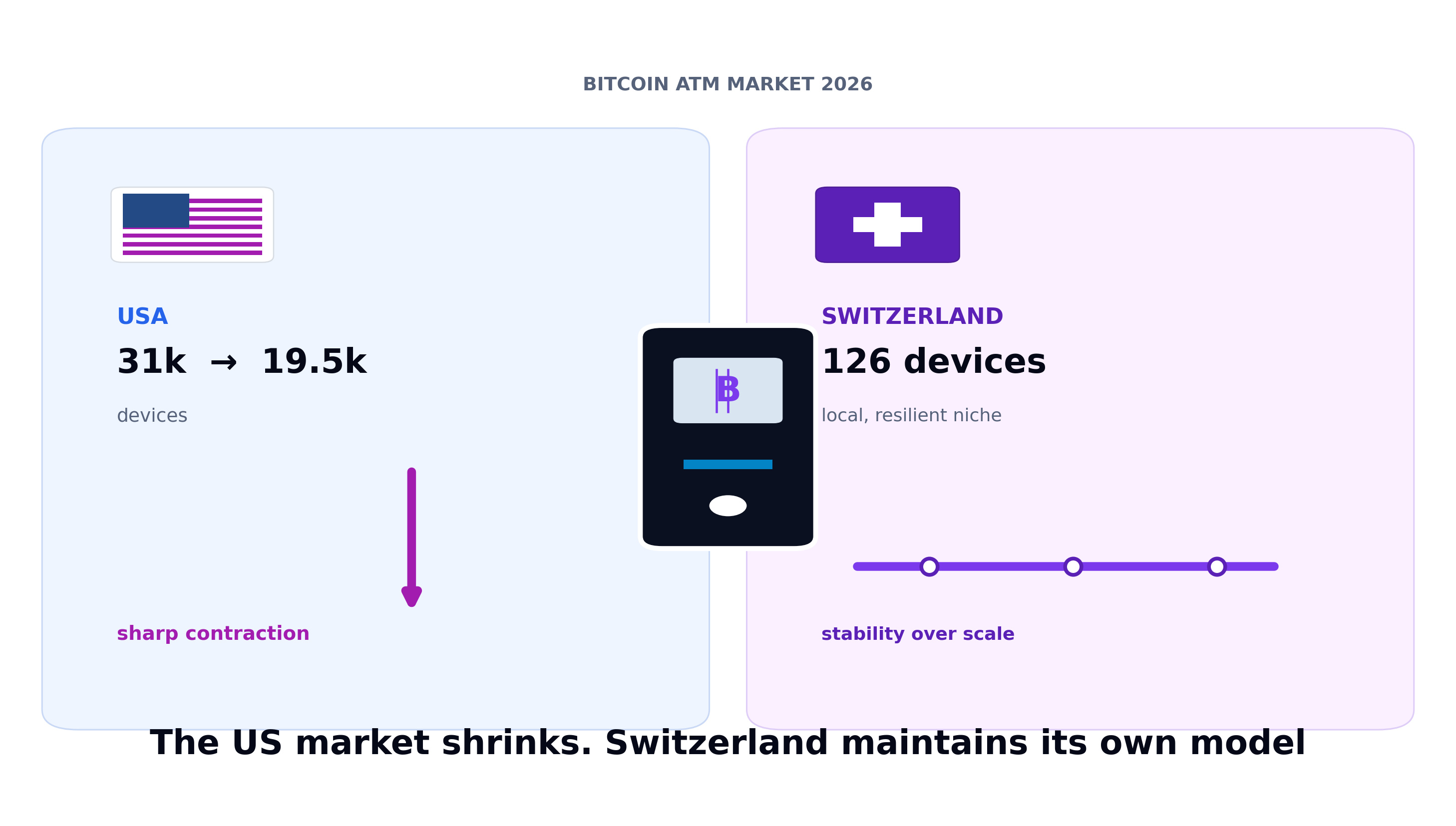
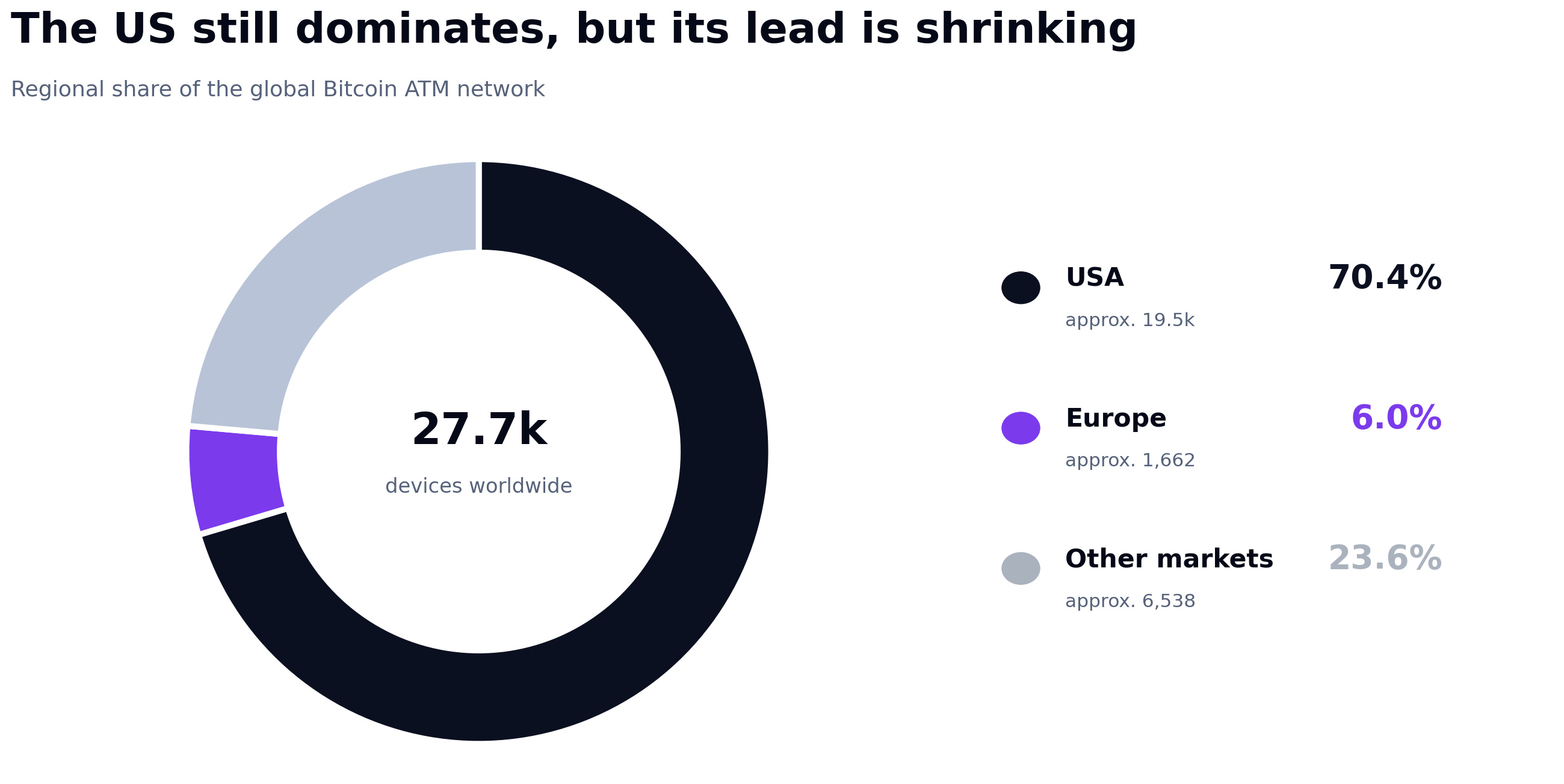
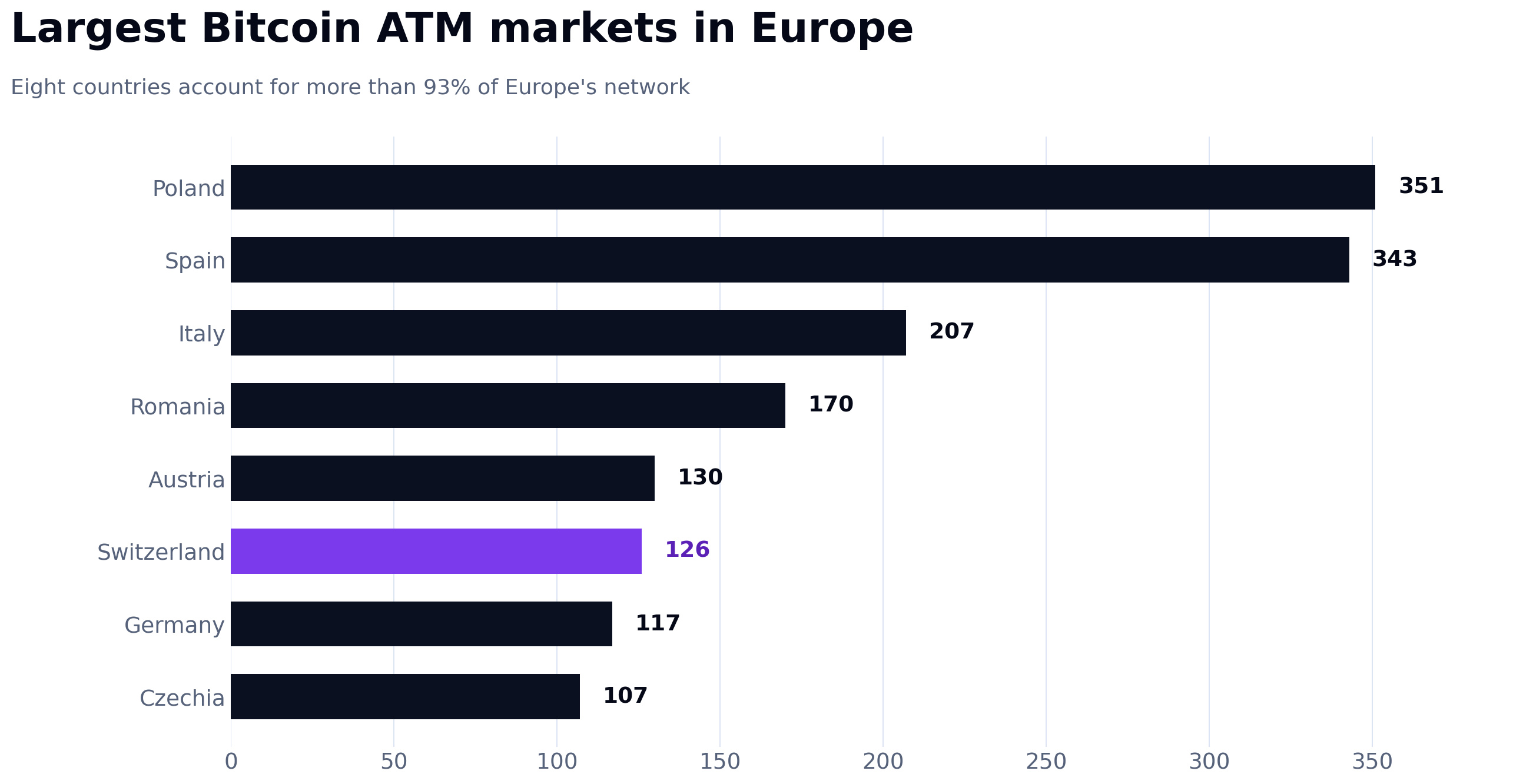
According to the latest Coin ATM Radar data, the number of Bitcoin ATM machines in the U.S. has fallen from more than 31,000 to about 19,500, while the global network has shrunk to approximately 27,700 machines. One of the most significant developments was the shutdown of Bitcoin Depot’s entire network after the company filed for Chapter 11 bankruptcy protection. Europe has approximately 1,662 machines and remains a highly concentrated market. Switzerland has about 126 Bitcoin ATM machines, but its advantage does not stem from scale alone. It is underpinned by the continued importance of cash, the well-developed Crypto Valley ecosystem, and local adoption in Lugano.
Figures on operator maps change continuously, so they should be treated as a snapshot of the market on a particular date, not as a fixed figure.
Source: Coin ATM Radar and country rankings, as of August 18, 2026.
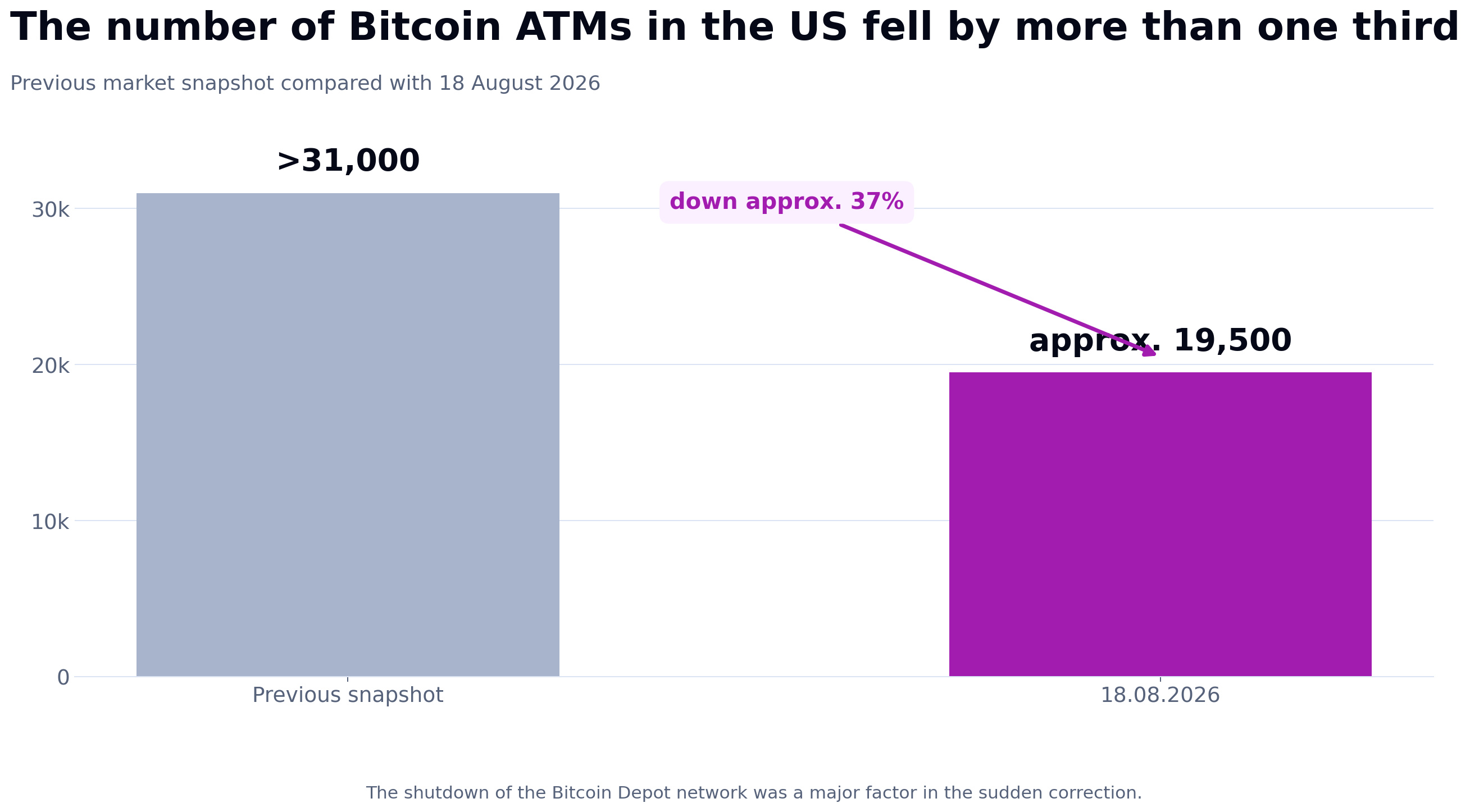
Just a few months ago, it was fair to describe the U.S. market as cooling. Today, that description is too mild. The decline from more than 31,000 to about 19,500 machines represents the loss of over one-third of the network. The U.S. remains the world’s largest market, but 2026 has exposed the vulnerability of a model built on the mass deployment of kiosks in stores, pharmacies, and gas stations.
The turning point came on May 18, 2026, when Bitcoin Depot commenced voluntary Chapter 11 proceedings. In a filing with the SEC, the company confirmed the shutdown of its entire network and the start of an orderly wind-down. An analysis of the 92-page first-day declaration identified approximately 9,700 inactive Bitcoin ATM kiosks across the U.S., Canada, and Australia. The entire decline in U.S. statistics therefore cannot be explained by the gradual removal of individual machines. A significant share of the correction was caused by the sudden disappearance of the largest Bitcoin ATM operator’s network.
This does not prove that interest in Bitcoin suddenly disappeared. Rather, it exposes the weakness of a model in which scale grew faster than the operator’s ability to manage risk, compliance costs, and legal disputes.
The pressure on operators does not stem solely from hostility toward cryptocurrencies. In 2025, the U.S. FBI/IC3 received exactly 13,460 reports of fraud involving crypto kiosks. Reported losses totaled $388,981,267. Complaints rose by 23%, while losses increased by 58% year over year. More than half of the reports involved people over 50, whose losses exceeded $302 million.
These data must be interpreted precisely. The FBI cautions that some reports also involved other forms of transfer. The full amount therefore cannot be attributed to kiosks alone. The machine is a payment channel used by the offender, not the originator of the fraud.
The typical pattern is nevertheless consistent: the scammer impersonates a bank, the police, a government agency, technical support, or a loved one; stays on the phone with the victim; sends a QR code; and creates time pressure. In response, states are introducing limits, mandatory warnings, refund rules, identity verification, and blockchain address monitoring. AARP reports that laws targeting Bitcoin ATM scams have already been enacted in more than 30 states. Indiana, Tennessee, and Minnesota have gone further by imposing complete bans on kiosk operations. Minnesota’s ban took effect on August 1, 2026.
Sources: Indiana General Assembly, Tennessee Department of Commerce & Insurance, Minnesota House of Representatives, SEC, and ESMA.
Europe did not become the new center of mass expansion. Its network comprises approximately 1,662 machines and remains concentrated in a handful of countries. Poland and Spain each have more than 340 Bitcoin ATM machines, followed by Italy, Romania, Austria, Switzerland, Germany, and the Czech Republic. Together, these eight markets account for more than 93% of Europe’s network.
In the previous analysis, MiCA could still be described as a regulation in the process of bringing order to the market. Since July 1, 2026, the situation has been different. The maximum transitional period has ended. ESMA expects unauthorized crypto-asset service providers to stop onboarding new clients and marketing immediately, and to limit their activities to an orderly wind-down and the protection of clients’ interests.
This does not mean the automatic closure of Bitcoin ATM machines in the European Union. It does mean, however, that a physical cash-to-crypto access point does not operate outside the regulatory system. The operator’s model, scope of services, CASP status, and national AML obligations determine which authorizations and controls are required.
Regulatory status as of August 18, 2026. Switzerland is not an EU member, so MiCA is not its primary legal regime.
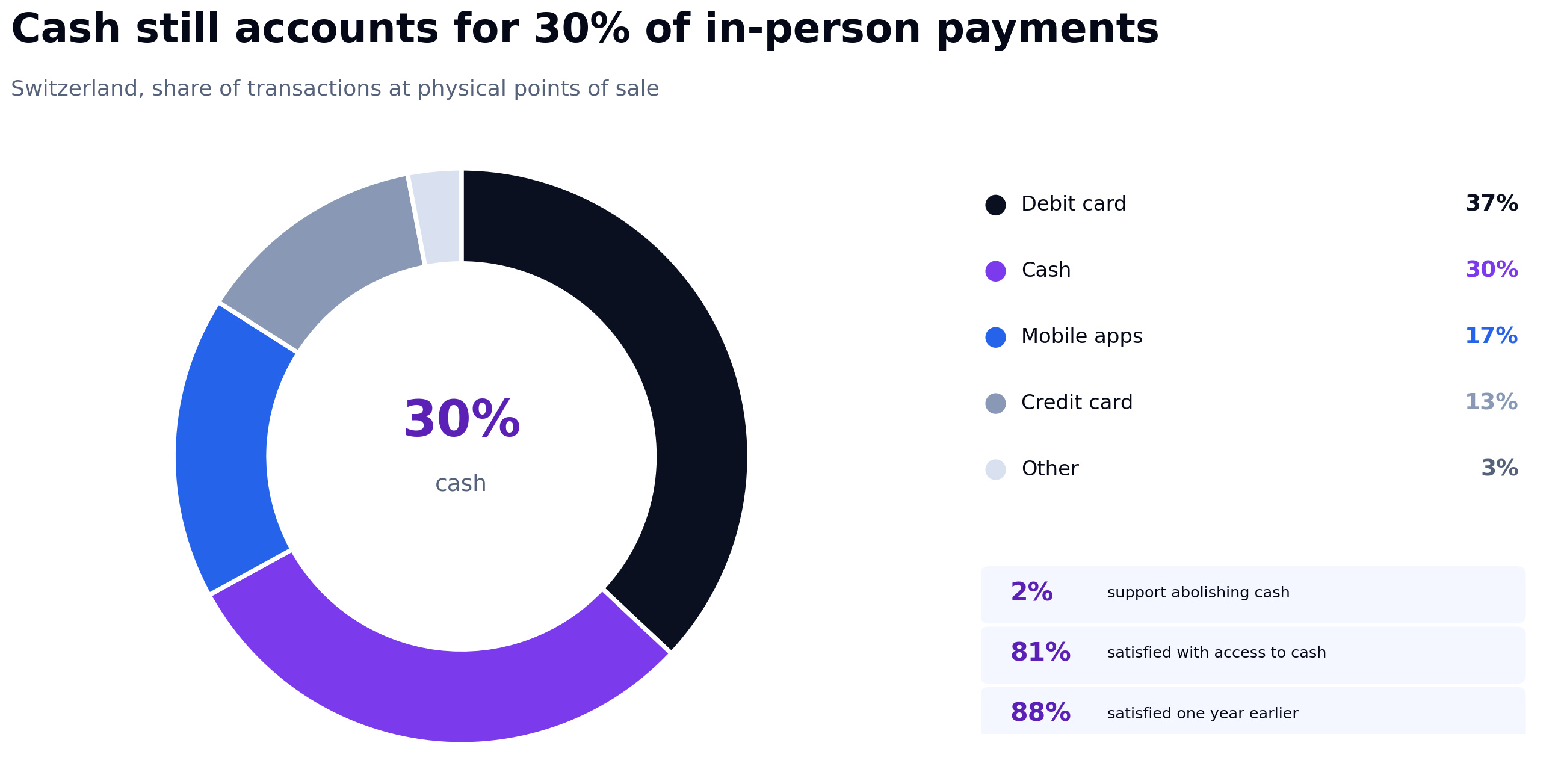
Switzerland is not a cash-only society. According to a Swiss National Bank survey published in March 2026, debit cards accounted for 37% of in-person payments, cash for 30%, mobile apps for 17%, and credit cards for 13%.
At the same time, only 2% of respondents support abolishing cash entirely. Satisfaction with access to cash withdrawal points fell from 88% to 81%, which the SNB links to the declining number of conventional ATMs. Cash is not dominant, but it remains an important element of choice, payment resilience, and control over how transactions are settled.
A network of 126 Bitcoin ATM machines does not make Switzerland Europe’s leader. The market’s significance comes from the environment in which the machines operate. The Crypto Valley Top 50 & Ecosystem Report 2026 identifies 1,766 active blockchain companies in Switzerland and Liechtenstein. In 2025, the ecosystem raised $728 million across 31 transactions and accounted for 47% of European blockchain funding.
Lugano is another example. According to Plan ₿, more than 360 local locations accept BTC, USD₮, or LVGA, while municipal charges and taxes can be paid in BTC and USDT. Bitcoin ATM machines are not an isolated technological curiosity there. They operate alongside companies, wallets, merchant acceptance, events, and public services.
Switzerland should not be presented as a market for anonymous transactions. The Travel Rule as applied to blockchain also requires verification that the customer controls the wallet used to access cryptoassets.
The scope of specific obligations depends on the business model, the relationship with a financial intermediary, and the risk assessment. In practice, a mature operator needs customer identification, transaction monitoring, sanctions procedures, recordkeeping, suspicious activity reporting procedures, and clear communication with users. The Rothbard website currently states that, under AML rules, all transactions require an identity document to be scanned. The relevant concepts are therefore data protection, transparency, and AML compliance - not anonymity.
Bitcoin ATM machines do not replace cards, apps, or exchanges. Their role is narrower - they are a specialized bridge between cash and a blockchain wallet. They can be useful for someone who wants to:
Convenience, however, should not obscure the cost. Before confirming a Bitcoin ATM transaction, users should check the buy or sell rate, the operator’s fee, the network fee, the limit, and the amount of crypto that will actually reach their wallet.
2026 is not the year of a Bitcoin ATM revival. It is a year of selection. The U.S. model of mass expansion has suffered a serious blow, while Europe maintains a much smaller and more concentrated network. Switzerland demonstrates that physical access to crypto can remain useful when it meets local demand and is embedded in a broader financial, technological, and regulatory ecosystem.
The future of this industry no longer depends solely on the number of machines. More important are reliable locations, up-to-date information, liquidity, transparent exchange rates, prompt support, effective AML procedures, and protection against fraud. Switzerland does not need tens of thousands of machines to remain one of Europe’s most interesting Bitcoin ATM markets.
According to Coin ATM Radar, 126 Bitcoin ATM machines were operating in Switzerland as of August 18, 2026. The figure may change at any time, so the latest snapshot should be checked before publishing an update.
Not as Switzerland’s primary legal regime, because Switzerland is not an EU member. Bitcoin ATM operators are governed by Swiss law, particularly AMLA and the rules and practices of FINMA or the relevant self-regulatory organization. MiCA may nevertheless be relevant if an entity provides services to clients in the EU.
Anonymity should not be assumed. Rothbard states that all transactions require an identity document to be scanned. Bitcoin ATM operators must also apply AML procedures and appropriate wallet and transaction controls.
Rothbard.eu is developing a platform that aggregates Bitcoin ATM locations in Switzerland, enabling users to find places where they can buy and sell BTC and other cryptocurrencies for cash. Bitcoin ATM kiosks are available in Zurich, Geneva, Basel, Lausanne, Lucerne, Lugano, Mendrisio, and other locations; their current status and cash availability can be checked online on the platform’s map.
This material is for informational purposes only. It does not constitute investment, tax, or legal advice.


