Help


Home > Blog > Article: “Bitcoin ATM in Switzerland: Market Size...”
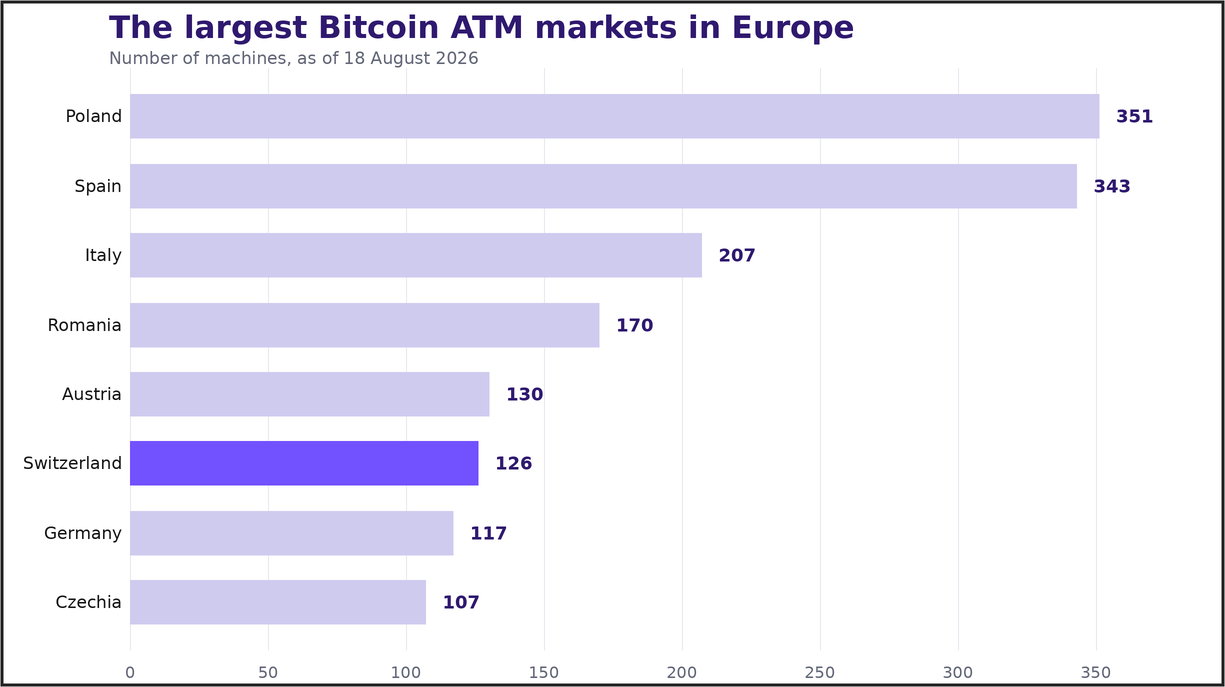
Switzerland is one of Europe’s most important blockchain hubs, but it does not lead in terms of the number of Bitcoin ATM installations. According to data from August 18, 2026, 126 devices were operating in the country. They serve a specific role: connecting cash transactions with users’ own wallets and complementing exchanges and apps rather than replacing them.
It is worth distinguishing Switzerland’s importance to the blockchain industry from the scale of its domestic Bitcoin ATM network. Switzerland is a major hub for blockchain companies and industry funding, while the devices are just one part of the infrastructure available to users.
According to a CV VC report published in April 2026, Crypto Valley comprises 1,766 active blockchain companies in Switzerland and Liechtenstein. In 2025, this ecosystem accounted for 47% of European blockchain industry funding.
These figures cover companies, blockchain networks, infrastructure, financial services and consulting. Bitcoin ATM devices are only one of the ways this ecosystem connects with retail users. Their role should therefore be neither understated nor presented as the main reason for Switzerland’s standing.
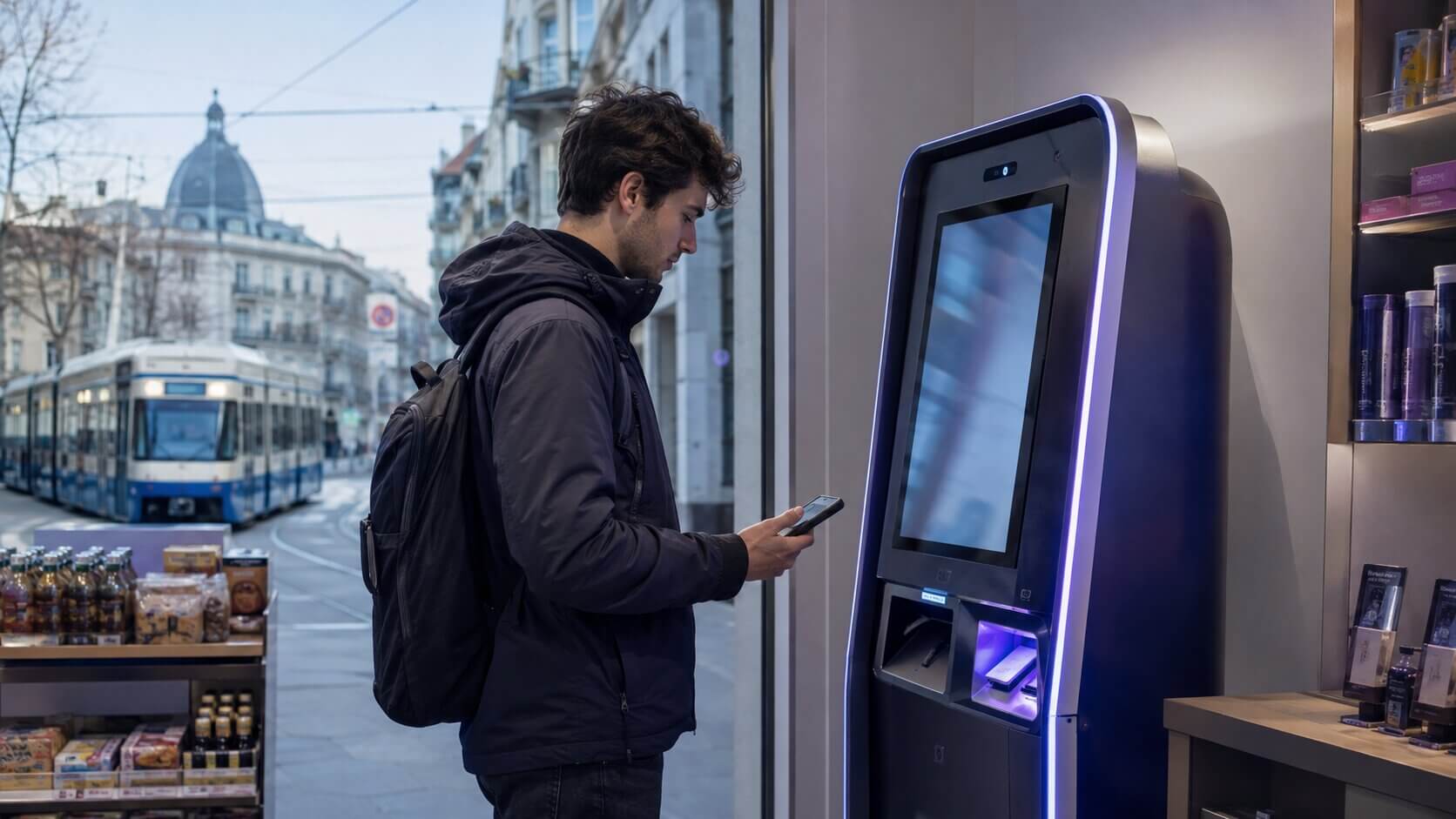
A Bitcoin ATM is not an ATM in the traditional sense. It does not dispense funds from a bank account or hold a user balance. It is a physical exchange point: in BUY mode, it accepts cash and sends cryptocurrency to the specified address; in SELL mode, it accepts a cryptocurrency transfer and, once the transaction requirements have been met, dispenses cash.
This distinction has practical significance. The device can be convenient for someone who has cash and wants to fund their own wallet without first making a bank transfer. Two-way devices also make it possible to sell supported cryptocurrency and receive CHF or EUR. However, users still need their own wallet and must assess the transaction cost.
The latest Swiss National Bank survey illustrates this context well. In 2025, debit cards accounted for 37% of transactions at physical points of sale, cash for 30%, mobile apps for 17% and credit cards for 13%. Cash was not the dominant method, but it remained the second most frequently used.
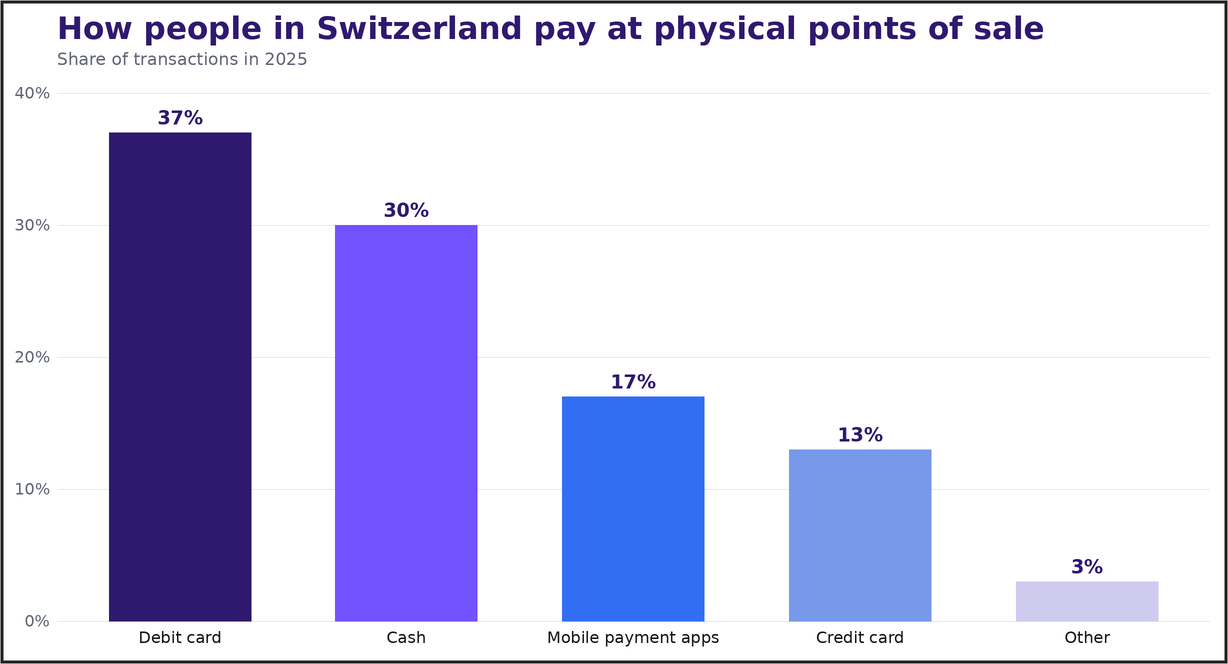
These data do not mean that Bitcoin ATM devices compete directly with cards or payment apps. The devices address a different need: exchanging cash for cryptocurrency or cryptocurrency for cash.
There is no single method that suits every user. The choice depends on the source of funds, expected processing time, cost, access to banking services and experience using one’s own cryptocurrency wallet.
A Bitcoin ATM is particularly useful when a user wants to use cash and receive cryptocurrency directly in their own wallet. An online exchange, by contrast, meets the needs of people who use bank transfers, cards and trading tools.
According to Coin ATM Radar, Switzerland had 126 reported machines as of August 18, 2026. The number changes as machines are installed or decommissioned and their statuses are updated, so it should always be published together with the relevant date.
The features and quality of a specific location are equally important. Not every machine supports selling, not every location is open 24 hours a day and the availability of cash for withdrawal may change throughout the day. For users, an up-to-date map showing the address, opening hours, status and BUY/SELL functionality is more useful than the nationwide total alone.
As of August 18, 2026, the Rothbard.eu location map covered 11 locations in eight cities. It shows locations in this network, not all ATM Bitcoin devices operating in Switzerland.
Check the latest data: the Bitcoin ATM map for Switzerland and the nationwide Coin ATM Radar aggregator.
Switzerland is one of Europe’s major blockchain hubs, but it does not lead in terms of the number of Bitcoin ATM installations. These devices serve a specific purpose: they enable exchanges between cash and users’ own cryptocurrency wallets. For users, the most important details are BUY or SELL functionality, the device’s current status, the exchange rate and the location.
According to Coin ATM Radar, 126 machines were operating on August 18, 2026. The number changes over time, so the snapshot date should always be included when publishing an update.
Not always. The final cost depends on the exchange rate, operator fees, the network fee and the exchange’s withdrawal rules. Exchanges usually charge lower trading fees, while a Bitcoin ATM offers cash handling at a physical location. Compare the final amount of cryptocurrency or cash after all costs.
No. Cash withdrawals are available only from machines with SELL functionality and depend on the current availability of banknotes. It is worth checking the status before visiting.
Yes. When buying, the machine sends cryptocurrency to the specified wallet address. When selling, the user sends the required amount from that wallet to the operator. Users should verify the address and retain control of their wallet keys.
The Crypto Valley data come from the CV VC report published in April 2026 and cover Switzerland and Liechtenstein. The payment-method data come from the Swiss National Bank’s 2025 survey. The number of ATM Bitcoin devices reflects the figure reported by Coin ATM Radar in August 2026.
This material is for informational purposes only. It does not constitute investment, tax, or legal advice.