Help


Home > Blog > Article: How Many Bitcoin Millionaires Are There…
Updated: August 10, 2026
The most recent global estimate comes from the Crypto Wealth Report 2025, prepared by Henley & Partners using data from New World Wealth. According to the report, there were 145,100 Bitcoin millionaires worldwide - people whose BTC holdings were worth at least $1 million.
The total number of crypto millionaires was estimated at 241,700. Bitcoin millionaires thus accounted for about 60% of this group.
The report was published on September 23, 2025, but the market valuation presented in it was as of June 2025. It is therefore not a real-time measurement, but rather the most recent global estimate available.
For comparison, there were 85,400 Bitcoin millionaires in 2024. The increase to 145,100 represents a rise of approximately 70% year over year. However, this figure depends primarily on the BTC price and the study methodology, so a similar pace should not automatically be assumed in subsequent years.
Bitcoin is transparent at the transaction and balance levels, but pseudonymous at the owner level. The public blockchain shows how much BTC is held at a specific address and how funds move over time. However, it does not contain a complete list of the names of the individuals, companies, funds, or custodial service clients behind those addresses.
This results in two opposing distortions.
First, a single person can control multiple addresses. An investor can distribute their BTC across a hardware wallet, several cold storage addresses, an exchange account, and an address used for day-to-day transactions. In this case, they do not appear as a single owner in the on-chain data.
Second, a single address may represent the funds of multiple individuals. Exchanges, custodial firms, funds, or entities managing investment products may hold clients’ assets in shared addresses. In the rich list, such an address appears as a single, very large holder, even though economically, thousands of clients may be behind that balance.
This distinction explains why different sources publish different figures. Henley and New World Wealth use wealth models to estimate the number of people. BitInfoCharts counts publicly visible addresses based on their value. Both approaches are useful, but they answer different questions.
These figures are a good indicator of the concentration of value on the blockchain, but they do not constitute a list of millionaires. Among the largest identified addresses are, among others, exchanges’ cold wallets. The balance of such an address does not automatically represent the assets of a single person. On the other hand, a true Bitcoin millionaire may hold funds across multiple addresses, none of which individually exceeds $1 million.
It is also worth remembering that the BitInfoCharts counter is dynamic. When the BTC price changes by a few percent, thousands of addresses close to the threshold may move above or below the $1 million mark without any new transaction taking place.
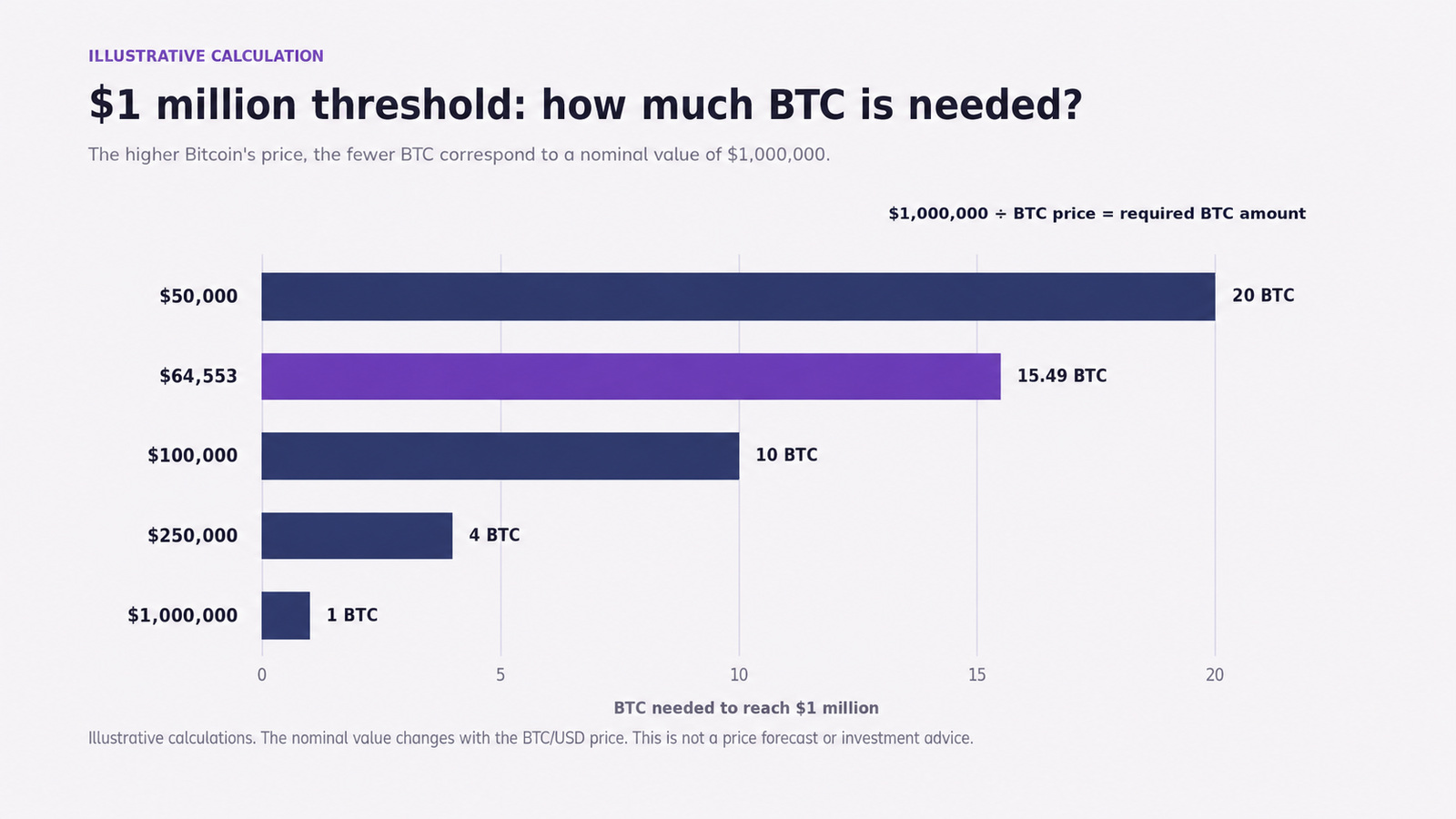
The calculation is simple:
This is a nominal and variable value. If the price of Bitcoin rises, the number of BTC needed to exceed the threshold decreases. When the price falls, the threshold expressed in BTC increases. A holder of 15.5 BTC may therefore be above the $1 million threshold one day and, following a price change, fall below it again, even without making any transactions.
At the current exchange rate—no. Exactly 1 BTC would only reach a value of $1 million if the price were $1 million per Bitcoin. For less than 1 BTC to be worth a million dollars, the exchange rate would have to be even higher. For example, 0.5 BTC would be worth $1 million at a price of $2 million per BTC, and 0.1 BTC would be worth $1 million at a price of $10 million per BTC.
This is not a price forecast, but a simple mathematical calculation showing the relationship between the balance and the exchange rate.
These terms are often used interchangeably, but they do not mean the same thing.
A Bitcoin millionaire is a person whose BTC holdings are worth at least $1 million.
A crypto millionaire is a person who holds crypto assets with a total value of at least $1 million. The portfolio may include BTC, ETH, stablecoins, tokens, and other digital assets. This is why the Henley report identifies more crypto millionaires than Bitcoin millionaires.
A Bitcoin whale is an informal term for a very large BTC holder. There is no single official threshold. Depending on the analysis, the term refers to addresses or entities controlling hundreds or thousands of bitcoins. At the current price, an entity holding that many coins exceeds the $1 million threshold, but most Bitcoin millionaires do not have to be whales.
It’s also important to note the difference between an address and its owner. An exchange address holding tens of thousands of BTC may appear to be a “whale,” even though it represents the deposits of many customers. In contrast, someone holding about 15.5 BTC may meet the criteria for a Bitcoin millionaire but remain a relatively small market participant.
There are no reliable public statistics showing how many Bitcoin millionaires live in Switzerland or are tax-resident there. Henley’s global estimate cannot be broken down by country unless the source publishes such a breakdown.
However, Switzerland remains an important player in the digital asset market. In the Crypto Adoption Index 2025, Henley ranked it among the top five jurisdictions analyzed. The report also highlights Switzerland’s importance as a hub for custody services. The local ecosystem encompasses banking, technology companies, asset custody services, investment products, and physical channels for market access.
One such channel is Bitcoin ATMs, which allow users to buy or sell supported cryptocurrencies for cash. The current Rothbard map shows locations in Zurich, Geneva, Lucerne, Lugano, Winterthur, and Mendrisio, among others.
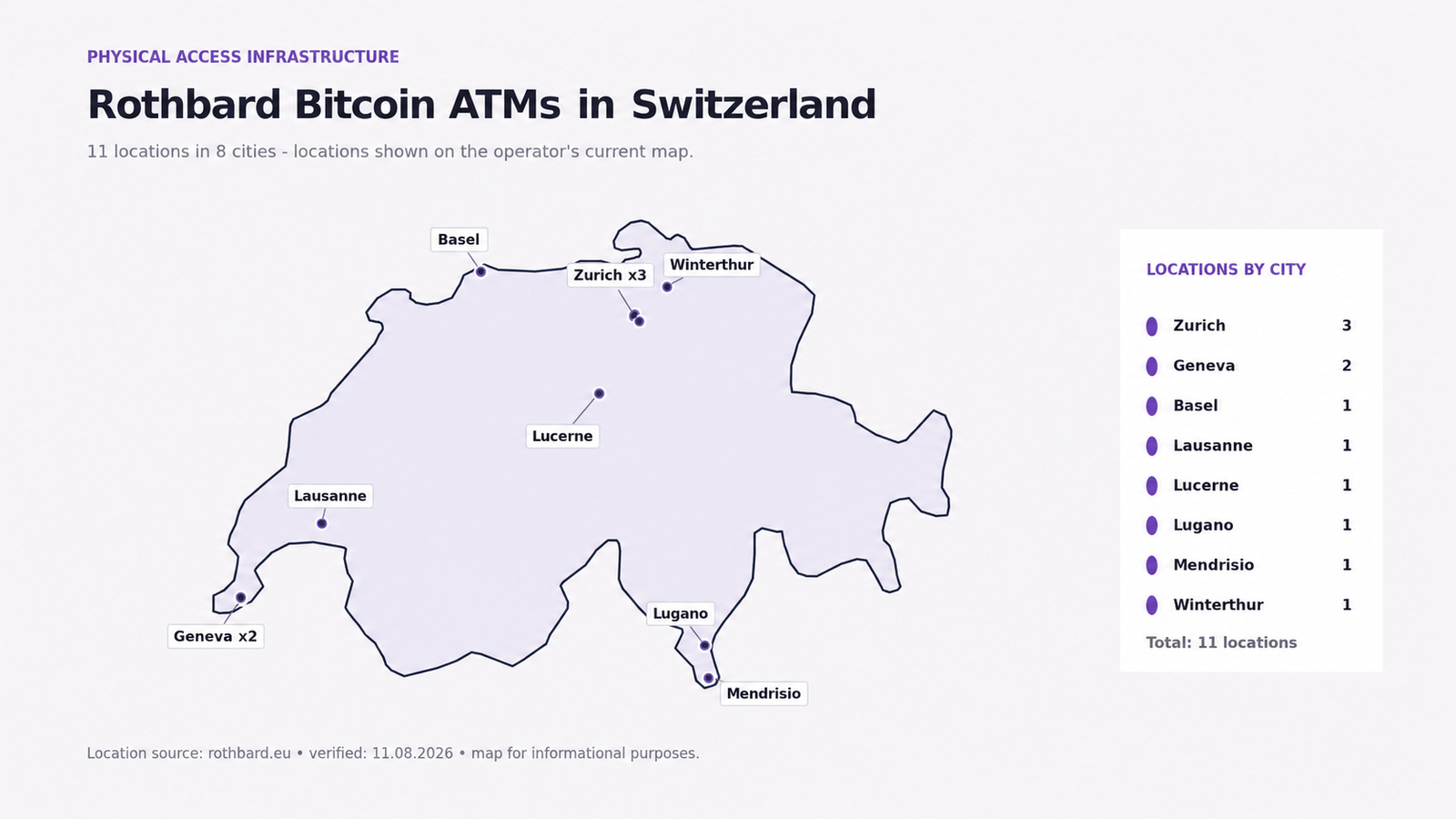
Important: This does not imply that Bitcoin millionaires primarily use Bitcoin ATMs. It simply means that Switzerland has both the institutional infrastructure and physical access points for BTC users.
In this article, we distinguish between three types of information.
Estimate of the number of individuals: Henley & Partners and New World Wealth use their own wealth threshold models and publicly available data on large crypto holdings. The figure of 145,100 represents the modeled number of individuals with at least $1 million worth of BTC. This is not a list of verified owners.
On-chain address data: BitInfoCharts groups addresses according to the value of their balances. The count of 111,801 addresses above $1 million and 14,025 above $10 million was taken on August 6, 2026. The data changes with the BTC price and the distribution of balances.
Threshold expressed in BTC: The figure of 15.49 BTC is obtained by dividing $1 million by the reference price of $64,553 per BTC. It is a snapshot, not a fixed threshold.
In this article, we do not equate an address with a person, a wallet with a single address, or a custodian’s balance with the wealth of one client. This keeps the figures comparable without presenting them with greater precision than the sources allow.
Sources:
According to the latest available Crypto Wealth Report 2025, there are an estimated 145,100 such individuals. The report identifies individuals holding at least $1 million worth of BTC and is based on the New World Wealth model, not on a public registry of owners.
According to BitInfoCharts data from August 6, 2026, 111,801 BTC addresses had exceeded the $1 million threshold. This number is dynamic and should not be equated with the number of people.
On August 6, 2026, BitInfoCharts reported 14,025 addresses with a value exceeding $10 million. These large addresses may include holdings of exchanges, custodial firms, and other entities that hold funds on behalf of multiple clients.
No. A single person can control multiple addresses, and a single address can hold funds belonging to multiple people. An address is a technical component of the blockchain, not a verified identity of the owner.
At a price of $64,553 per BTC, approximately 15.49 BTC is required to reach a value of $1 million. The threshold changes with the price: divide $1,000,000 by the current price of one BTC.
Theoretically, yes, but only if the price is higher than $1 million per BTC. For example, 0.5 BTC would be worth $1 million if the price of Bitcoin were $2 million. At the price on August 6, 2026, less than 1 BTC is worth significantly less than one million dollars.
A Bitcoin millionaire has BTC holdings worth at least $1 million. A crypto millionaire can reach this threshold through an entire portfolio of digital assets, including other cryptocurrencies and tokens.
Not in the full sense of the word. Bitcoin is pseudonymous: addresses, balances, and transactions are public, but personal information is not stored directly on the blockchain. Once an address is reliably linked to a specific person or entity, its activity can be analyzed.
No. There are no reliable public figures showing exactly how many Bitcoin millionaires live in Switzerland. However, the country has a well-developed digital asset ecosystem, encompassing custody services, banking, fintech, investment products, and physical points of market access.
The figure of 85,400 comes from the Crypto Wealth Report 2024. In the 2025 edition, the estimate rose to 145,100. When comparing data, you should always check the report’s year, the valuation date, and the methodology.
This is an informal term for a very large holder of BTC. There is no official threshold, but it usually refers to an address or entity that controls hundreds or thousands of bitcoins. Not every Bitcoin millionaire is a whale.
Rothbard.eu is developing a platform that aggregates Bitcoin ATM locations in Switzerland, enabling users to find locations where they can buy and sell BTC and other cryptocurrencies for cash. Bitcoin ATMs are available in cities including Zurich, Geneva, Basel, Lausanne and Lucerne; their current status and cash availability can be checked online on the website’s map.
This material is for informational purposes only. It does not constitute investment, tax or legal advice.