
Help



Home > Blog > Article: “Who Really Controls Your Money at a Bitcoin ATM in Switzerland?...”
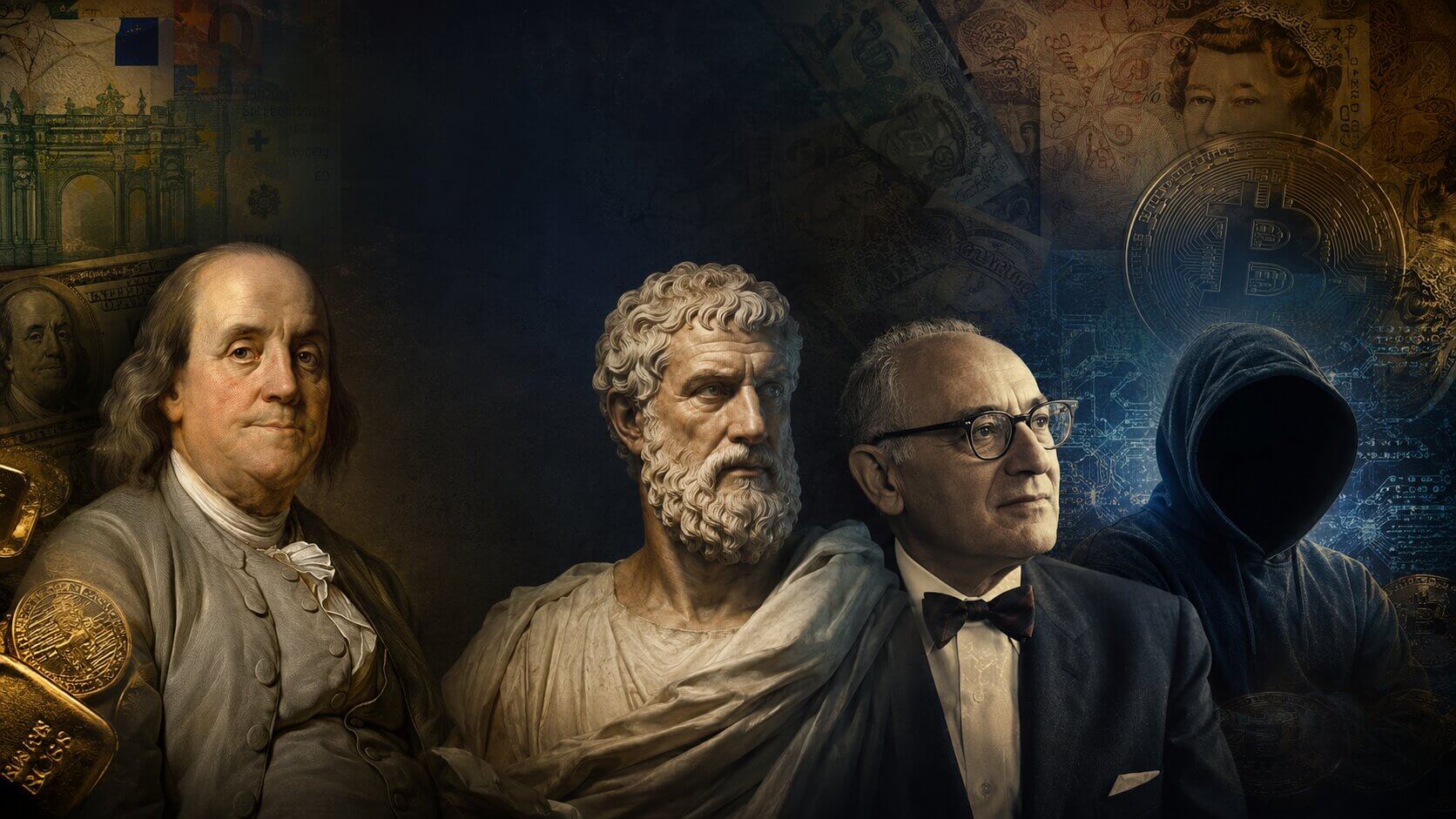
From Seneca and Benjamin Franklin to Murray Rothbard and Satoshi Nakamoto. Words showing that financial freedom begins with understanding money.
Money allows us to preserve the fruits of our labor, plan for the future, and make choices. At the same time, its value depends on the system, institutional decisions, and public trust.
The following quotes are not only about earning money. They also address time, debt, inflation, ownership, cash, and Bitcoin. Each quote includes a source, and versions in other languages are our own translations.
Benjamin Franklin - Advice to a Young Tradesman
Franklin was not claiming that every minute of life should generate a profit. Rather, he was reminding us that wasted time - like poorly allocated capital - cannot be recovered.
Benjamin Franklin - The Way to Wealth
Access to someone else’s capital comes at a price. Interest is only part of that price. Debt can restrict choices, increase pressure, and make the future dependent on the creditor.
Epicurus, as quoted by Seneca - Moral Letters to Lucilius
This is one of the oldest yet most relevant definitions of wealth. If needs grow faster than wealth, even a high income does not provide a sense of security.
Henry David Thoreau - Walden
Financial freedom does not depend solely on how much we earn. How much we need to maintain our current lifestyle is equally important.
Ralph Waldo Emerson - The Conduct of Life
Money can cost time, health, independence, or work that goes against your own values. Not every gain, therefore, amounts to genuine enrichment.
Warren Buffett - 2008 Letter to Berkshire Hathaway Shareholders
Price is immediately visible. Value only reveals itself over time. This applies to stocks, real estate, and Bitcoin, as well as to financial services and decisions made under the influence of emotion.
Adam Smith - An Inquiry into the Nature and Causes of the Wealth of Nations
Money is ultimately backed by human labor. A banknote, a coin, or an entry in an account is a way of measuring and transferring value over time.
Bank of England - Money Creation in the Modern Economy
This is not a conspiracy theory but a description of how modern banking works. Much of the money in the economy is created when banks make loans, not by physically printing banknotes.
John Maynard Keynes - The Economic Consequences of the Peace
Inflation doesn't have to destroy a currency overnight. It's enough for it to gradually erode the currency's purchasing power over the years, making it harder to save and plan for the long term.
Milton Friedman - Inflation, Taxation, Indexation
Friedman pointed out that inflation reduces the real value of cash and savings without the need to impose a formal tax.
Murray N. Rothbard - Essentials of Money and Inflation
Rothbard was one of the most outspoken critics of the state’s monopoly on money. He believed that the ability to increase the money supply always creates a temptation to abuse it.
Friedrich A. Hayek - 1984 interview
Hayek advocated for competition among different types of money. Several decades later, the rise of cryptocurrencies reignited the debate over whether money must be issued exclusively by the state.
Swiss Confederation - Preamble to the Federal Constitution
Freedom is not a passive state. It requires the ability to choose - including among cash, a bank account, digital payments, and self-custodied assets.
Swiss Confederation - Article 27 of the Federal Constitution
This short sentence aptly describes the Swiss approach. Financial innovation can develop, but this takes place within a framework of law, oversight, and operator accountability.
Swiss National Bank - Press release of 21 November 2025
In Switzerland, the share of cash in in-person payments fell from over 70% in 2017 to about 30% in 2024. Despite this, a significant portion of the population still wants the option to pay and store value outside of fully digital systems.
Satoshi Nakamoto - Bitcoin White Paper
Bitcoin does not eliminate all risks. However, it changes their structure: instead of entrusting settlement to a single institution, it relies on public protocol rules and a decentralized network.
Satoshi Nakamoto - 2009 post on the P2P Foundation forum
When we use a bank, we place our trust in many entities at once: a commercial bank, a central bank, regulators, and IT systems. Bitcoin was created as an attempt to reduce this dependence.
Nick Szabo - Trusted Third Parties Are Security Holes
An intermediary can enhance convenience and security, but it also becomes a single point of control and a potential point of failure. This is precisely the problem that decentralized financial systems are trying to solve.

The most important lesson from these 18 quotes is neither “banks are bad” nor “Bitcoin will solve every problem.” It is much simpler: financial freedom requires understanding the tools we use.
A bank account offers convenience and institutional protection. Cash provides direct access to money and greater privacy in everyday payments. Bitcoin can reduce dependence on intermediaries, but it requires knowledge, caution, and responsibility for safeguarding funds.
Switzerland is an interesting example of these different models coexisting. Traditional banking, cash, and digital assets operate side by side here. At their intersection are, among other things, Bitcoin ATM locations in Switzerland, which connect physical cash with users' digital wallets.
They do not replace banks or exchanges, nor do they eliminate risk. They simply show that Bitcoin can be accessed in different ways. Regardless of the solution chosen, understanding the costs, how it works, and the responsibilities involved in the decision remains essential.
True financial freedom does not mean using only one system. It means being able to make an informed choice.
Yes. Each quote has been verified against the original publication, an official document, or an archive of the author's work. The versions in other languages are our own translations.
Yes, but operators must comply with Swiss regulations, including anti-money laundering requirements.
No. Bitcoin enables users to hold and transfer funds independently, but it does not eliminate price risk, user error, fraud, or the responsibility of securing a wallet.
As a rule, a confirmed Bitcoin transaction cannot be reversed in the same way as a card payment or bank transfer. You should therefore carefully check the wallet address and transaction details before sending funds.
Bitcoin is not managed by a single bank, government, or company. The network runs according to shared protocol rules enforced by independent users, nodes, and miners. No single participant can unilaterally change the system's rules.
No. Bitcoin is divisible into 100 million smaller units called satoshis. This means you can buy a small fraction of a Bitcoin for any chosen amount in Swiss francs or another currency.
On an exchange, the keys to the funds are usually controlled by the platform operator. With a self-custody wallet, the user controls the keys but is solely responsible for keeping them and the backup secure. Each option therefore carries a different type of risk.
NEW!
Rothbard.eu is developing a platform that aggregates Bitcoin ATM locations in Switzerland, enabling users to find locations where they can buy and sell BTC and other cryptocurrencies for cash. Bitcoin ATMs are available in cities including Zurich, Geneva, Basel, Lausanne and Lucerne; their current status and cash availability can be checked online on the website’s map.
This material is for informational purposes only. It does not constitute investment, tax or legal advice.


