


.png)
How many people use Bitcoin? The latest statistics and adoption data (2026)

Home > Blog > Article: “How many people use...”
Short answer: According to the Crypto.com Crypto Market Sizing 2025 report, approximately 365 million people owned Bitcoin. River, taking a more conservative estimate, puts the number at around 300 million people, or roughly 4% of the world’s population. The exact number cannot be confirmed because Bitcoin does not have a central user registry.
This does not mean that 365 mln people pay with BTC every day. Most people treat Bitcoin mainly as an investment, a way to gain financial exposure, or a store of value, rather than as a regular payment method.
Updated: June 16, 2026
According to Crypto.com, the number of global cryptocurrency holders rose from 659 million in 2024 to 741 million in 2025, while the number of BTC holders increased from 337 million to 365 million. Triple-A estimated that in 2024 over 562 million people worldwide held digital currencies, corresponding to approximately 6.8% of the global population.
The most important conclusion is simple:
Bitcoin has hundreds of millions of holders, but far fewer people use it on a daily basis for transactions or payments.
What does it mean to use Bitcoin?
It’s worth distinguishing between three levels of adoption: holding BTC, investment exposure through an exchange or financial product, and the actual use of Bitcoin for payments and transfers. These are three different behaviors that shouldn’t be lumped together into a single statistic.
The phrase "using Bitcoin" can mean several different things. That is the main reason why such a wide range of figures can be found online.
Many articles answer the simpler question: How many people own Bitcoin? But the question of how many people use Bitcoin is a broader one.
You can own BTC without ever using it to make payments. You can trade Bitcoin without directly using the blockchain. You can also make payments through an app where the user sees a simple interface, while the conversion of BTC, stablecoins, or fiat currency takes place in the background.
That's why the best answer isn't "X people." A better answer is a set of numbers that clearly show exactly what we're counting.
A reasonable current estimate is approximately 300–365 million Bitcoin holders worldwide.
In its Crypto Market Sizing 2025 report, Crypto.com estimates the number of BTC holders at 365 million. The same report cites a total of 741 million global cryptocurrency holders, meaning that BTC holders accounted for approximately 49.3% of global crypto holders under this methodology.
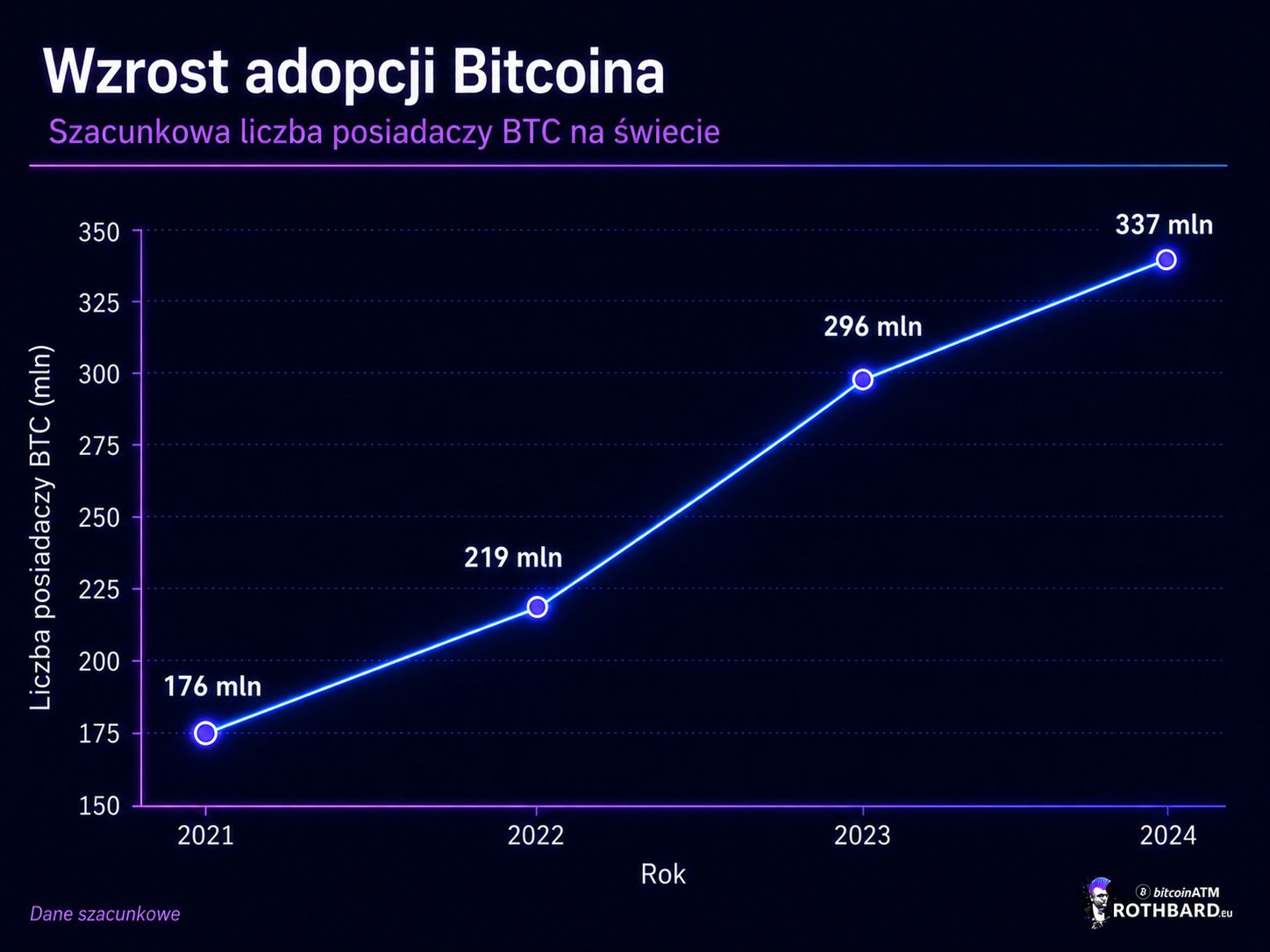
River offers a more conservative estimate: approximately 300 million Bitcoin holders, or about 4% of the world’s population, according to data from May 2026.
So, the most practical answer for 2026 is:
According to Crypto.com, approximately 365 million people own Bitcoin, while River’s more conservative estimate puts the figure at around 300 million. The exact number cannot be confirmed because Bitcoin does not have a central user registry.
This scope may include various types of ownership:
- people who hold BTC in their own wallets;
- people holding BTC on exchanges;
- users of fintech apps and brokers;
- people with very small account balances;
- investors with indirect exposure to BTC through financial products.
However, this does not mean that 300–365 million people pay with Bitcoin every day.
Search results show a wide range of figures: 25 million, 106 million, 300 million, 365 million, 480–500 million, 562 million, or 741 million. Some of these may be useful, but they usually measure different things.
Bitbo highlights how important methodology is: it cites figures such as 106 million Bitcoin owners, 400,000 daily users, 200 million wallets, and 53 million traders, but also clearly states that no one knows the exact number of BTC users.
The safest conclusion:
Lower estimates typically refer to active wallets, self-custody, or older counting methods. Higher estimates often include exchange users, app users, survey respondents, indirect exposure, or all cryptocurrency holders—not just BTC holders.
How many people use Bitcoin every day?
There is no exact figure for the number of daily Bitcoin users. The best publicly available estimates are:
- active Bitcoin addresses;
- number of on-chain transactions;
- exchange activity;
- payment processor data;
- Lightning Network activity;
- app and wallet activity.
River notes that the number of active Bitcoin addresses per day hovers around 600,000, but also emphasizes that an address is not the same as a person. Meanwhile, a current snapshot from BitInfoCharts dated June 6, 2026, showed 562,680 transactions in the last 24 hours and 118,013 active addresses during the same period.
These figures show two things.
First, daily on-chain activity varies. Depending on the day, the source, and the method of calculation, the figures may differ.
Second, even the best on-chain data does not reflect the number of people. A single user can execute multiple transactions. A single transaction can have multiple recipients. An exchange can serve thousands of customers while executing a limited number of on-chain transactions. Some activity in custodial apps and the Lightning Network may also not be directly visible on the main blockchain.
Therefore, the honest answer is:
Daily on-chain Bitcoin usage should be measured in terms of hundreds of thousands of active addresses and transactions, rather than hundreds of millions of people.
The number of people who own Bitcoin is much larger than the number of people who regularly pay with Bitcoin.
There is no reliable global counter for BTC payments. The data is scattered across on-chain transactions, the Lightning Network, payment processors, crypto cards, exchanges, custodial apps, and payments that are instantly converted to local currency. Additionally, many reports measure total cryptocurrency payments rather than strictly Bitcoin payments.
In practice, it is helpful to distinguish between three cases:
NEW!Bitcoin is most commonly used as a payment method today in specific niches:
- international transfers;
- censorship-resistant donations and funding;
- selected online services;
- travel and major purchases;
- gift cards and vouchers;
- local BTC communities hold Bitcoin
- situations where access to banking services is limited or expensive.
Daily BTC payments are much less common than simply holding BTC. Today, Bitcoin is more often used as an investment asset, a long-term store of value, and a settlement network than as a universal retail payment method.
The biggest flaw in Bitcoin adoption statistics is treating wallets, addresses, or exchange accounts as if they were people.NEW!
Bitbo highlights the crux of the issue: a single person can have multiple wallets and addresses, and large platforms may store multiple users’ BTC at a single address. Many users also keep their BTC on centralized platforms and never set up their own self-custody wallet.
The rule is simple:
Blockchain shows addresses and transactions, not specific individuals. Therefore, on-chain data is very useful for assessing network activity, but it is not a simple measure of the number of real Bitcoin users.
National data are harder to interpret because many reports measure ownership of cryptocurrencies in general rather than ownership of Bitcoin specifically.
Triple-A estimates that in 2024, global adoption of digital currencies stood at approximately 6.8%, with the number of digital currency holders exceeding 562 million. Among the countries with high adoption rates, Triple-A lists, among others, the United Arab Emirates, Singapore, Turkey, Argentina, Thailand, and Brazil.
This data is useful, but it must be described precisely:
Cryptocurrency adoption by country is not the same as the number of Bitcoin users by country.
The key difference lies in control. An exchange account may provide exposure to BTC, but it does not always mean that the user actually owns Bitcoin. Full control begins only when the user manages their own private keys.
Nevertheless, several clear patterns are evident.
NEW!
.png)
Emerging markets are leading the way in adoption
In many developing countries, Bitcoin and cryptocurrencies are linked to specific financial needs:
- protection against inflation;
- access to global digital finance;
- international transfers;
- saving outside of weak local currency systems;
- money transfers;
- limited confidence in the local banking infrastructure.
That is why countries such as Brazil, Nigeria, Argentina, and Turkey frequently appear in analyses of crypto adoption.
Developed markets
In developed countries, Bitcoin is more commonly used as:
- investment assets;
- theses on long-term value storage;
- portfolio diversification tools;
- product available through ETFs, brokers, and regulated platforms;
- custody assets and wealth management.
In the U.S. and parts of Europe, institutional products and regulated access are becoming increasingly important.
Why should country rankings be treated with caution?
A country may have high cryptocurrency ownership but low use of Bitcoin for payments. Another country may have strong institutional exposure but few active self-custody users. Yet another may have a small number of holders but very active local Bitcoin communities.
Therefore, one should not claim that a particular country has the most Bitcoin users if the source measures only the overall adoption of cryptocurrencies.
Switzerland deserves a special mention because it is one of Europe's strongest cryptocurrency markets.
A Bitpanda/YouGov survey found that Switzerland ranked first among the European countries analyzed: 23% of the population already held cryptocurrencies in their wallets. The figure was even higher among younger age groups: 32% of millennials and 29% of Gen Z.
These figures concern cryptocurrencies in general, not Bitcoin specifically. They still show that Switzerland has a high level of digital asset adoption compared with many other European markets.
Switzerland's importance stems from several factors:
- a strong financial infrastructure;
- wealth management and private banking;
- fintech and blockchain regulation;
- custody services;
- with high purchasing power;
- active crypto communities;
- local access points, such as Bitcoin ATMs.
For users in Switzerland, Bitcoin adoption isn’t limited to exchanges and apps. It also includes physical infrastructure that allows users to buy or sell BTC for cash, in accordance with local AML/KYC regulations.
Important: Bitcoin ATMs do not show how many people use Bitcoin in Switzerland. They are an example of local access infrastructure, not a measure of the number of users.
%20(1)%20(1).jpg)
Switzerland shows that Bitcoin adoption isn’t limited to exchanges, apps, and investment products. Physical access points that allow people to buy or sell BTC for cash are also important. For many people, this kind of contact with Bitcoin can be simpler than opening an account on an exchange. Bitcoin ATMs lower the barrier to entry, help less technical users, and connect digital assets with the real-world financial infrastructure.
Bitcoin adoption grows as more and more people have a reason and an easy way to access BTC. The key factors are economic, technological, and institutional.
1. Investment demand
For many people, Bitcoin is primarily an investment asset or a long-term store of value. Such users may not make transactions every day, but they still “use” BTC as part of their savings or investment strategy.
2. Institutional products
Spot Bitcoin ETFs and regulated investment products have made it easier for investors who do not want to manage their own portfolios and private keys to access BTC. Crypto.com notes that the rise in adoption in 2025 was driven, among other things, by institutional factors and a more crypto-friendly policy in the U.S.
3. Simpler apps and exchanges
Buying Bitcoin used to require technical knowledge. Today, many users buy BTC through mobile apps, exchanges, brokers, fintech companies, and custodial wallets.
4. Self-custody tools
Hardware wallets, mobile wallets, MPC wallets, and increasingly user-friendly interfaces are making it easier to store BTC on your own.
5. Inflation and currency volatility
In some countries, Bitcoin is attractive because users are looking for an alternative to a weak local currency, capital controls, or an unstable banking system.
6. International transfers
Bitcoin can be used for global value transfers. It can be useful in situations where bank transfers are slow, expensive, or restricted.
7. Local access infrastructure
Bitcoin ATMs, local brokers, and physical access points can make it easier for people who prefer cash or don’t want to start with an exchange account to access BTC for the first time.
There are also clear barriers to Bitcoin adoption.
1. Price volatility
The price of Bitcoin can fluctuate wildly. This makes it difficult to use BTC as a day-to-day unit of account and a stable payment method.
2. Technical complexity
Self-custody requires an understanding of wallets, backups, private keys, and the irreversibility of transactions. For beginners, this can still be difficult.
3. Security Risks
Losing private keys, phishing, or scams can result in the permanent loss of funds. That is why education and secure storage are crucial.
4. Regulations and Taxes
Regulations vary by country. Some users avoid Bitcoin because they don’t know how to report it for tax purposes or what the applicable legal rules are.
5. Payment friction
When it comes to everyday payments, Bitcoin competes with cards, bank transfers, mobile wallets, and stablecoins. In many developed countries, existing payment systems are already convenient.
6. Seller Preferences
Merchants often prefer to receive local currency rather than a volatile asset. Payment processors can convert BTC to fiat, but that makes the transaction a less direct Bitcoin payment.
7. The difficulty of measurement
Much of this activity takes place through exchanges, custodial apps, ETFs, payment processors, and the Lightning Network. Public blockchain data therefore does not provide the full picture.
Bitcoin adoption is likely to continue growing, but not all forms of adoption will grow at the same pace.
BTC ownership and investment exposure are likely to grow the fastest, as exchanges, apps, brokers, and ETFs make it easy to buy Bitcoin without any technical interaction with the blockchain.
Daily payment usage may grow more slowly. For Bitcoin to become a more common payment method, we need simple wallets, low costs, clear regulations, tools for merchants, and interfaces that don’t require technical knowledge. The Lightning Network can facilitate fast, low-cost payments, but some Lightning activity is harder to measure because not all transactions are directly visible on the main blockchain.
The most realistic scenario is that Bitcoin will continue to serve several functions at once:
- long-term savings asset;
- speculative investment;
- settlement network;
- assets in self-custody;
- international transfer tools;
- a niche payment method;
- infrastructure layers for financial products.
Hundreds of millions of people own Bitcoin. Hundreds of thousands of addresses use the blockchain on any given day. A smaller group—one that is difficult to quantify precisely—uses BTC regularly for payments.
Methodology
In this article, we distinguish between five categories that are often confused.
NEW!Sources used in this article:
- Crypto.com - data on 365 million BTC holders and 741 million cryptocurrency holders in 2025.
- River - An estimate of 300 million BTC holders and an explanation of the difference between ownership and use of the blockchain.
- BitInfoCharts - real-time data on transactions, active addresses, price, and Bitcoin network statistics.
- Triple-A - Global Data on Digital Currency Owners in 2024.
- Bitbo - a methodology covering users, wallets, addresses, and exchange accounts.
- Bitpanda / YouGov - Data on cryptocurrency adoption in Switzerland.
- TradingView / Cointelegraph - An explanation of the challenges in measuring actual Bitcoin payments.
This article deliberately does not treat addresses, wallets, or exchange accounts as people.
How many people use Bitcoin?
There is no exact publicly available figure for the number of Bitcoin users. The best practical range is about 300–365 million people holding BTC, depending on the source and methodology. Daily on-chain activity is much lower and is measured in active addresses and transactions rather than in hundreds of millions of people.
How many people own Bitcoin worldwide?
Crypto.com estimates that there were 365 million BTC holders in 2025. River provides a more conservative estimate: approximately 300 million people, or roughly 4% of the world’s population, according to data from May 2026. The difference stems from differing methodologies and definitions of ownership.
What percentage of the world's population owns Bitcoin?
A reasonable current estimate is about 4–4.5% of the world’s population, depending on whether we use an estimate of 300 million or 365 million holders and which population base we adopt. This is an estimate, not an official user count.
How many people use Bitcoin every day?
There is no exact figure for the number of daily BTC users. Active addresses and the number of transactions provide a good estimate. River reports that active addresses hover around 600,000 per day, and BitInfoCharts provides real-time snapshots of network activity. However, addresses are not people.
How many Bitcoin transactions take place each day?
In the most recent verified snapshot on BitInfoCharts, Bitcoin recorded 562,680 transactions in the last 24 hours. This figure changes daily. It counts transactions, not people: one person can make multiple transactions, and a single transaction can have multiple recipients.
Are Bitcoin addresses the same as users?
No. A Bitcoin address is not a person. A single person can control multiple addresses, and a single exchange address can hold BTC belonging to many customers. Address data is useful for network analysis, but it does not reveal the exact number of users.
How many Bitcoin wallets are there?
It is impossible to accurately count the number of active Bitcoin wallets. Some websites report the number of wallets or accounts, but a single person may have multiple wallets, and many wallets may be empty or inactive. Bitbo cites 200 million Bitcoin wallets as a broad metric, but clearly states that wallets are not the same as users.
How many people pay with Bitcoin?
There is no exact global figure. The data is scattered across on-chain payments, Lightning Network transactions, payment processors, crypto cards, exchanges, and apps. Many reports measure total cryptocurrency payments, not just Bitcoin. Daily BTC payments are much less common than simply holding BTC.
Is Bitcoin used mainly for payments or as an investment?
Currently, Bitcoin is more often used as an investment asset, a long-term store of value, and a settlement network than as a means of everyday retail payment. Payments do exist, but they are less common than simply holding BTC.
How many people use cryptocurrencies in total?
Crypto.com estimates that by 2025 the global number of cryptocurrency owners reached 741 million people. Triple-A estimated that in 2024 over 562 million people owned digital currencies. These figures refer to cryptocurrencies in general, not to Bitcoin specifically.
Do 741 million cryptocurrency users mean 741 million Bitcoin users?
No. The figure of 741 million refers to all cryptocurrency holders, not just Bitcoin holders. Bitcoin is the largest cryptocurrency, but data on the entire crypto market should not be interpreted as the number of BTC users.
Which country has the most Bitcoin users?
There is no perfect global ranking of Bitcoin users by country. Most rankings measure total cryptocurrency holdings. Triple-A highlights high adoption of digital currencies in the UAE, Singapore, Turkey, Argentina, Thailand, and Brazil, among others.
Is Bitcoin adoption on the rise?
Yes, according to most ownership estimates. Crypto.com reports that the number of BTC holders rose from 337 million in 2024 to 365 million in 2025, while the total number of cryptocurrency holders increased from 659 million to 741 million. However, daily payment usage is growing more slowly than ownership.
Do 365 million people use Bitcoin every day?
No. 365 million is an estimate of the number of people who own BTC, not the number of daily users. Daily Bitcoin usage is much lower and is better measured by active addresses, on-chain transactions, and BTC payments.
Why do different sources give different figures?
This is because they count different things: self-custody wallets, exchange accounts, survey responses, active addresses, transactions, users who make payments, traders, exposure via ETFs, or all cryptocurrency owners. That’s why the figure can range from tens to hundreds of millions, depending on the methodology.
This article is for informational purposes only and does not constitute financial, investment, tax, or legal advice.
Why Are Bitcoin ATMs Important in Switzerland?
Bitcoin ATMs provide easy, physical access to BTC—including with cash—and lower the barrier to entry for people who don’t want to start with an exchange. They don’t reveal the exact number of Bitcoin users, but they are an important example of local infrastructure for accessing digital assets.
Rothbard.eu is developing a platform that aggregates Bitcoin ATMs in Switzerland, allowing users to find locations where they can buy and sell BTC and other cryptocurrencies for cash. The machines are available in cities such as Zürich, Genève, Basel, Lausanne and Luzern, and their current status and cash availability can be checked online on the service’s map.
This material is for informational purposes only. It does not constitute investment, tax, or legal advice.
On-chain data and network statistics verified: June 16, 2026