
Help



Home > Blog > Article: “Can You Withdraw Cash from a Bitcoin ATM?…”
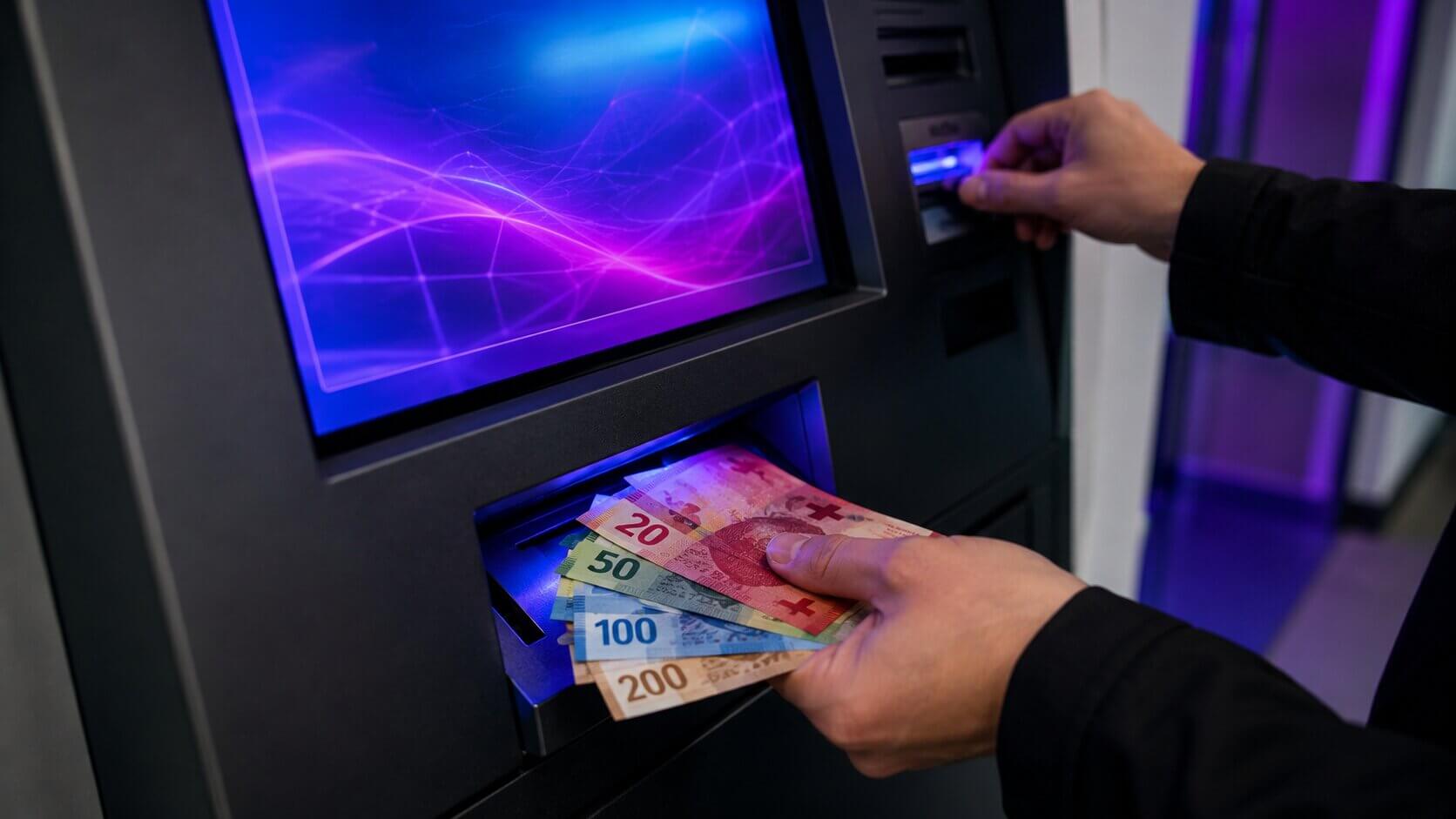
Yes, you can withdraw cash at certain Bitcoin ATM locations in Switzerland, but only from devices that allow you to sell cryptocurrency. You will need a cryptocurrency wallet containing enough Bitcoin.
A Bitcoin ATM, also known as a cryptocurrency ATM, resembles a conventional ATM but is not directly linked to a bank account. Instead, it allows users to buy cryptocurrency with cash and, at selected devices, to sell cryptocurrency and withdraw local currency.
The most important difference concerns the direction of the transaction. The buy function accepts banknotes and sends cryptocurrency to the specified wallet. The sell function accepts cryptocurrency, converts it at the operator’s exchange rate, and dispenses cash. Not every device supports both types of transactions.
Yes, but this applies only to two-way machines. Look for labels indicating support for selling cryptocurrency, withdrawing cash, or processing transactions in both directions.
Many popular devices are one-way only. You can insert cash and buy Bitcoin, but you cannot sell cryptocurrency or collect banknotes. Before travelling, check the operator’s website or device map, enable the ‘sell’ filter and make sure the specific location still supports cash withdrawals.
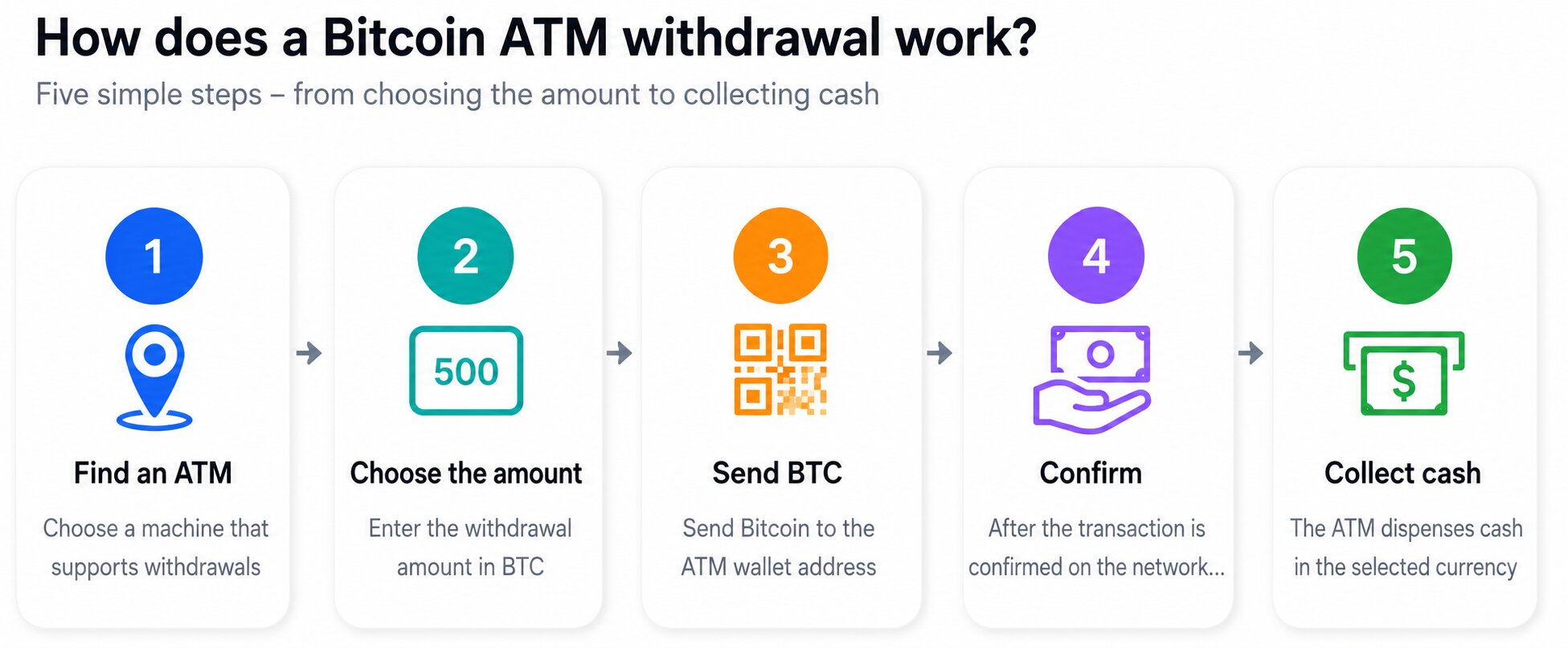
In practice, a cash withdrawal is a sale transaction. The ATM Bitcoin creates a quote for the selected amount, displays a wallet address or QR code and waits for the cryptocurrency to be sent. Once the required blockchain confirmations have been received, the device dispenses cash.
Some operators use a different model. You sell crypto in an app, receive a collection code and redeem it at a partner ATM. The outcome is similar, but the sale does not take place directly on the device’s screen.
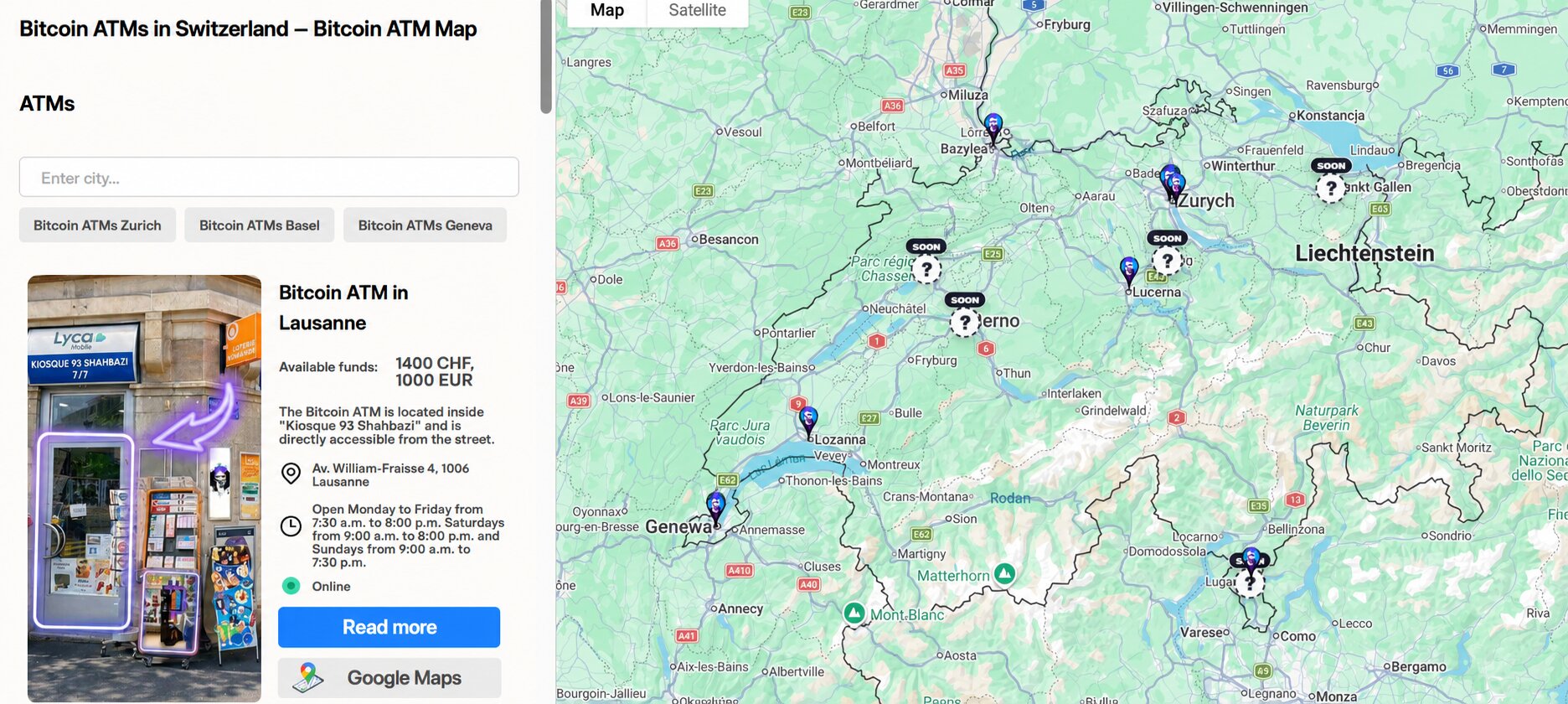
Open the Bitcoin ATM operator’s map and check which devices allow you to sell cryptocurrency for cash. Then verify the address, opening hours, supported cryptocurrencies, withdrawal currency and applicable limits.
Don't assume that all machines operated by the same provider have the same features. Some support purchases only, while others also support sales. Also check whether a withdrawal requires prior registration in an app.
On the screen, select the ‘Sell’ option, then enter the amount of cash you want to collect. The Bitcoin ATM will display the amount of BTC required to complete the transaction, the current exchange rate, the operator’s commission and the final cash withdrawal amount.
Before confirming, check the minimum transaction amount, applicable limits, and available denominations. Keep in mind that the exchange rate may change in real time, so the offer is usually valid only for a short time.
The ATM Bitcoin will display a QR code containing the operator’s wallet address. In your wallet, select ‘Send’, scan the code and check the first and last characters of the address. Make sure you are using the correct network, usually the native Bitcoin network.
Send exactly the amount of BTC indicated by the ATM Bitcoin. Add the network fee separately. If it is deducted from the amount being sent, the device may receive too little BTC and will not dispense cash.
Send funds only to the address displayed by the ATM Bitcoin or the operator’s official app.
Once the Bitcoin transaction has been sent, it enters the network. The operator waits for a specified number of confirmations to reduce the risk of double-spending. This usually takes several to around a dozen minutes, but it may take longer if the network is congested or the fee is too low.
After sending BTC, make a note of the transaction ID, or TXID. The ATM or operator’s system will wait for a specified number of network confirmations. The time required depends on network congestion, the transaction fee and the rules of the specific device. This may take several to around a dozen minutes, or longer during congestion. Keep the confirmation, TXID, transaction time and location number until the matter has been fully resolved.
Before you begin, gather the following:
No. The most common devices only sell cryptocurrency to the customer. Cash withdrawals require a two-way device.
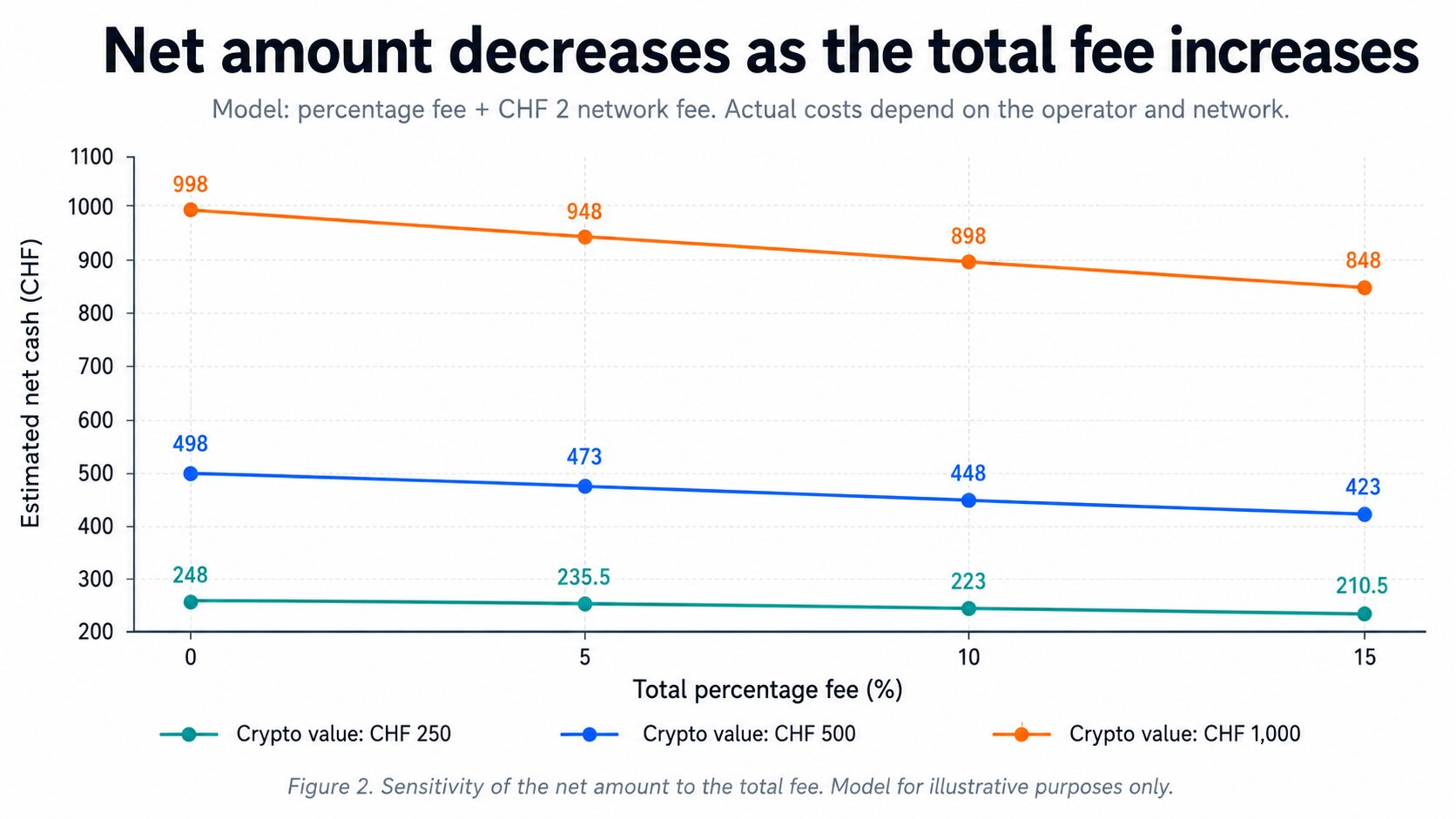
The total cost of a transaction is not always presented as a single fee. Part of the cost may be built into the BTC selling rate, while another part may be shown separately. The most meaningful comparison is the difference between the value of the Bitcoin you send and the amount of cash you actually receive.
Illustrative example: when selling BTC worth 500 CHF, with a 5% operator fee and a network fee of 2 CHF, the estimated amount of cash received would be 473 CHF. This is a mathematical example only, not an offer or a typical operator fee schedule.
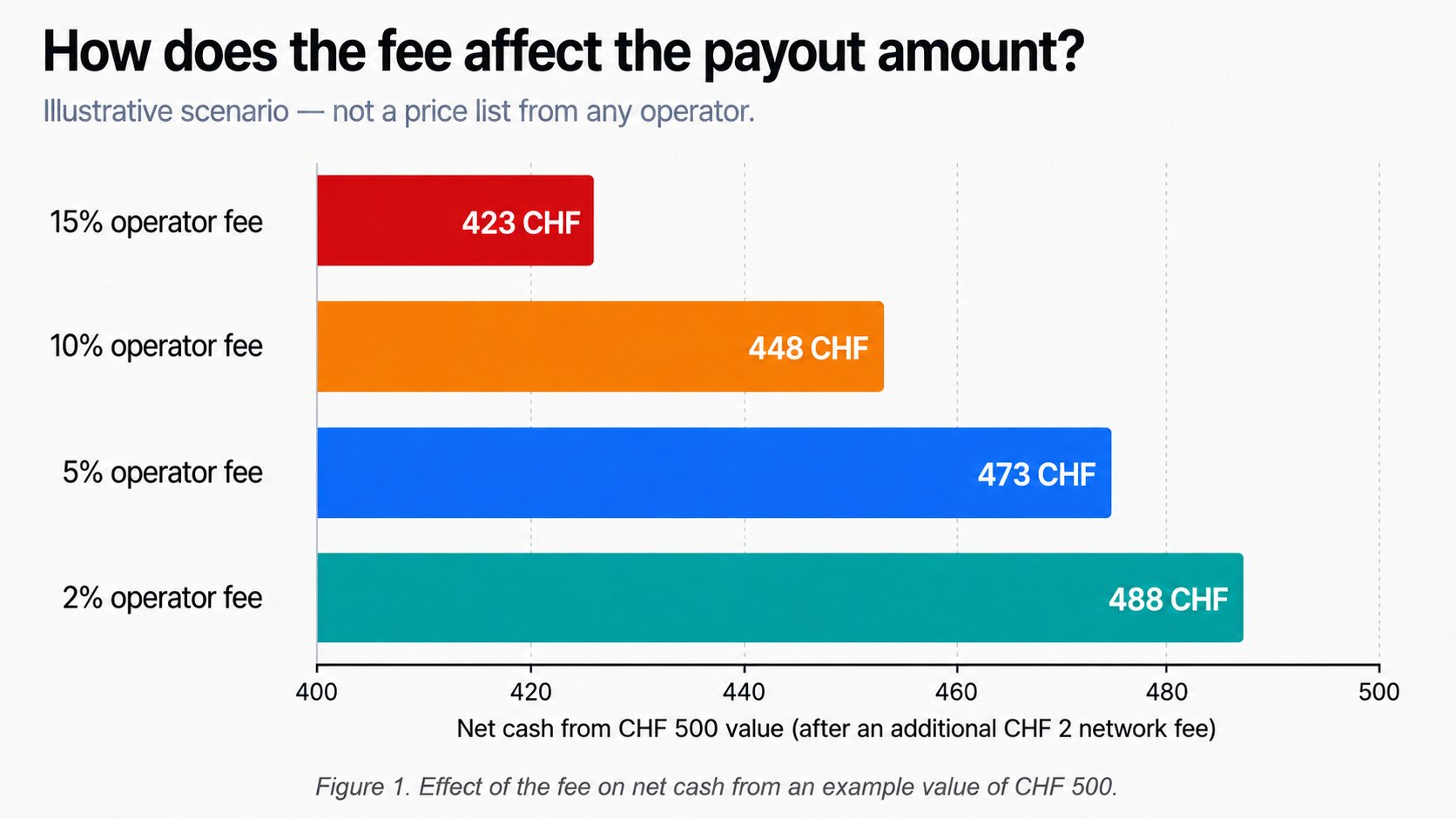
Assume that you are selling BTC worth 500 CHF or 500 EUR. If the total operator fee is 5% and the network fee is 2 CHF or 2 EUR, the estimated net amount would be 473 CHF or 473 EUR. This is a mathematical example only, not a price list or an indication of typical fees.
Practical tip: Do not assess a transaction solely by the commission percentage. Before confirming, check the amount of BTC being debited from the wallet and the exact net cash amount in CHF or EUR.
The following factors may all affect a withdrawal: the minimum transaction amount, the limit per transaction, the daily or monthly limit, the availability of banknotes, and verification requirements. The account limit does not mean that a specific machine has enough cash on hand.
In Switzerland, transactions involving the exchange of cryptocurrency for cash are subject to anti-money laundering rules. FINMA specifies a threshold of 1 000 CHF for related transactions over a 30-day period when cryptocurrency is exchanged for cash or other anonymous means of payment. However, the operator may require identification at a lower amount, depending on the risk, service model and its own procedures.
Note: Do not split one larger transaction into several smaller ones in order to avoid verification. Related transactions may be treated together, and the operator must follow its own AML and KYC procedures.
Usually not. The device requires a source of cryptocurrency, so you must send BTC from a wallet or sell assets held in an operator account. A mobile phone number or payment card alone cannot replace cryptocurrency funds.
The exception is a model based on a custodial app. The user sells crypto in the app, receives a code and collects cash at a partner ATM. The user does not use their own self-custody wallet when collecting the cash, but still holds cryptocurrency in a wallet or operator account.
They can be safe if you use a legitimate operator, initiate the sale yourself and check the details carefully. However, blockchain transactions are practically irreversible. An incorrect address, the wrong network or a transfer to a scammer may result in a permanent loss.
The Swiss Federal Office for Cyber Security warns that criminals use fake or altered QR codes to redirect payments. Financial devices and public institutions should never be used to comply with requests from a stranger who contacts you by phone or messaging app.
If you send the wrong amount, do not try to ‘fix’ the transaction yourself by making another transfer. Record the TXID, location number, time and confirmation, then contact the operator using the details on its official website.
A Bitcoin ATM is most useful when you want to collect cash locally and accept the cost shown before the transaction.
A Bitcoin ATM offers quick access to cash, but it is usually not the cheapest option. Before making a transaction, compare the exchange rate and total cost with those of an exchange or crypto card.
Cash withdrawals are available only at devices that support selling cryptocurrency. Check the ATM’s status, cash availability, currency, limits and net amount. Send the exact amount of BTC, wait for the required confirmations and keep the transaction receipt.
Use only your own wallet and initiate the transaction yourself. Never scan a QR code sent by a stranger or make a withdrawal on the instructions of a purported official, consultant or bank employee.
No. Only devices with the sell function, known as two-way machines, dispense cash. A ‘buy-only’ device allows you only to buy cryptocurrency with banknotes.
Usually several to around a dozen minutes. The time depends on the required number of confirmations, network congestion, the network fee, the operator and the method used to complete the transaction. It may take longer during congestion.
Usually not. You need a wallet from which you can send the cryptocurrency, or an operator account that holds the assets. In the collection-code model, the wallet may be built into the app.
Bitcoin is the most common. Litecoin, Ethereum, Solana, XRP, Dogecoin, USDC and other assets are also available in Switzerland. The list depends on the country, operator and specific device.
The transaction may remain pending or require manual processing. Do not send another transfer unless instructed to do so. Keep the TXID and contact the operator’s official support team.
They typically include the spread, operator fee, and network fee. There may also be a fixed fee or a withdrawal fee charged by an exchange. The net amount should be shown before confirmation.
Usually not. You sell cryptocurrency directly for cash. However, the operator may require a user account, a mobile phone number and additional identity verification.
Rothbard.eu is developing a platform that aggregates Bitcoin ATM locations in Switzerland, enabling users to find locations where they can buy and sell BTC and other cryptocurrencies for cash. Bitcoin ATMs are available in cities including Zurich, Geneva, Basel, Lausanne and Lucerne; their current status and cash availability can be checked online on the website’s map.
This material is for informational purposes only. It does not constitute investment, tax or legal advice.


